Part of the complete guide: How to improve your archery score
A stiff thoracic spine pushes the rotation the shot requires onto the pelvis and the shoulders, and short, high chest breathing keeps the nervous system on alert. No transformation is needed: five to ten degrees more thoracic mobility is enough to change the biomechanics measurably. Coherent five-five breathing, six breaths a minute for eight to twelve minutes a day, works the same lever, and morning HRV tells you when to ease off, because more than twenty per cent below your own mean means the load is too high.
At full draw the limits of the torso become visible: if the thoracic spine is stiff, the rotation the shot requires comes from the pelvis and the shoulders instead, and the base of support moves; if the breath is short and high in the chest, the nervous system stays in a state of alert that can be read in the aim, because the sight moves more and the bow arm starts hinting at a tremor. They are two different flaws, but they start in the same place, and to understand them you have to look at the three variables that govern them.
The first is thoracic mobility, which sets how much rotation the torso grants the shot. The second is diaphragmatic breathing, the most direct tool for shifting the nervous system toward calm. The third is HRV, heart rate variability, which is the daily measurement of that system: every morning it says how the body is responding to the load. The three influence one another, which is why it makes sense to train them as a single piece of work. The cost, for that matter, is low: a few minutes a day, no equipment, at most an app for the measurement.
If they stay neglected, it is because they are low-visibility work: an hour on technique can be seen, a new accessory can be touched, while ten minutes of breathing on the sofa leave no trace. So most archers give years to the movement and the equipment, and almost nothing to these three variables, which are the base the movement rests on.
Thoracic rotation
The thoracic spine is made of 12 vertebrae and has a specialty: because of how its facet joints are oriented, it moves more in rotation than in flexion and extension, the opposite of the lumbar segment. In archery that is the trait that matters, because during the draw the torso rotates against the pelvis by a few tens of degrees, and that rotation has to come from where it was designed to come.
When the thoracic spine stiffens, and it does through sitting, screens and the absence of rotational stimulus, the body takes the rotation from somewhere else. The typical compensations are three: the pelvis rotates, and the base of support destabilizes; the shoulders shift, and the alignment of the bow arm changes; the lumbar spine hyperextends, and stores a tension that over the months favours overuse problems. None of the three can be felt while it happens: they show up on the target as inconsistency with no apparent cause.
Research on rotational sports, golf, tennis, throwing, indicates that no transformation is needed: gains of 5-10 degrees of thoracic mobility are enough to change the biomechanics of the movement measurably. For an archer the transfer is direct: more available rotation means a quieter shooting posture, cleaner alignment, less dirty work asked of the shoulder.
Your own rotation can be estimated at home, with a simplified version of a test physiotherapists use in stricter form. Sit astride a chair, so that the pelvis stays locked, and hold a stick across your shoulders, behind the neck. Rotate the torso to one side, feet planted, without leaning, and have someone photograph you from above, or read the angle of the stick against the backrest. Repeat on the other side. The home measurement is rough and should not be read to the decimal; it serves to reveal a marked asymmetry between sides and to give you a starting point to re-photograph a month later, under the same conditions. The direction of change is trustworthy even when the exact number is not.
One more distinction is worth making, between the acute effect and the chronic one: the minutes of exercises before a session temporarily free up some range, which is why they belong in the warm-up; the stable change, the one you find again when cold, comes instead with weeks of regular practice, because tissue adapts to the repeated dose and not to the single session. Measuring right after the exercises therefore gives a number inflated by the acute effect, which will have faded by evening.
The diaphragm: breathing and posture
The diaphragm is the main muscle of breathing: it descends when you inhale, creating the pressure drop that fills the lungs, and rises when you exhale. That is the job everyone knows about, whereas the second is less known: together with the pelvic floor, the internal obliques and the transversus abdominis, the diaphragm governs the intra-abdominal pressure that stabilizes the spine in complex movements. It is therefore a breathing muscle and a postural muscle at the same time, and in a sport where breath and stability share the same seconds, this double function matters a great deal.
There is also a mechanical reason mobility and breath share one article: on the inhale the upper ribs move like the handle of a pump being lifted, the lower ribs like the handle of a bucket swinging out, and those are the two classic images of respiratory anatomy. A full breath is an expansion in every direction, forward, sideways and also backward, into the back. If the thoracic segment is stiff, the rib cage moves little in each of these directions and the diaphragm works in a reduced space. The complete chain is this: stiff spine, ribs that barely move, limited diaphragm, chest breathing.
Breathing with the chest, shoulders rising at every inhale and the abdomen still, means dumping the work on the accessory muscles of the neck, raising cervical tension and sending the nervous system one precise message: alert. Breathing with the diaphragm, the abdomen expanding before the chest, the cycle long and soft, sends the opposite message. Sport psychophysiology has documented it: slow diaphragmatic breathing stimulates the vagus nerve and shifts the balance of the autonomic system toward the parasympathetic side within a couple of minutes. The result is a state of alert calm rather than drowsiness, and it is the useful state before shooting.
One clarification, to keep the levels apart: the shift toward calm induced by breathing practice is a different thing from the heart rate slowdown expert archers show in the seconds right before release. That bradycardia belongs to the preparation of the movement, arrives on its own with experience, and cannot be performed deliberately; slow breathing prepares the general conditions, while that specific phenomenon belongs to the mature shot.
Slow breathing: six breaths per minute
Research on slow breathing converges on a rate of around six breaths per minute, that is a cycle of roughly ten seconds, as the zone where the effects on the autonomic system become most pronounced. At that rhythm the breath falls into resonance with the natural oscillations of blood pressure, and respiratory sinus arrhythmia, the physiological speeding up of the heart on the inhale and slowing down on the exhale, reaches its widest amplitude. The heartbeat starts oscillating with the breath in a wide, regular way, which for the autonomic system is a sign of good regulation. Heart rate variability biofeedback works on this same principle.
The structured techniques are different ways of reaching the same result: slowing the breath down and giving the mind a count to follow. The table lines them up, each with its most suitable moment.
| Technique | Rhythm | When to use it | Note |
|---|---|---|---|
| Coherent 5-5 | 5 s in, 5 s out, no pauses | Daily practice, 8-12 minutes | The ten-second cycle: exactly six breaths per minute, the rhythm the research converges on |
| Box 4-4-4-4 | 4 s in, 4 hold, 4 out, 4 hold | Pre-competition and pre-shot | The four-beat count gives structure and occupies the mind: useful when arousal climbs |
| 4-7-8 | 4 s in, 7 hold, 8 out | Moments of high arousal | The long exhale deepens the vagal braking; learn it at rest before using it under pressure |
The shared principle counts more than the labels: long exhales and a slow rhythm, whereas the exact seconds and the name of the technique mostly serve as scaffolding to get there. The useful dose is eight to twelve minutes a day, seated or lying down, somewhere quiet. For the first weeks the pattern feels unnatural, because for most adults it is: years of stress and sitting build the habit of chest breathing. From the fourth to sixth week the diaphragm starts working on its own again, and the pattern begins transferring to everyday breathing as well.
The table shows an asymmetry: the exhale is never shorter than the inhale, and in the 4-7-8 it is twice as long. The reason is physiological: the heart slows mostly during the exhale, the phase in which the vagal action on the heart is strongest, so lengthening the exhale lengthens the part of the cycle that slows things down. Counting seconds has one further use: it gives the mind a simple, repetitive task, which in the minutes before a competition helps against rumination.
A few pointers cover the practice: breathe through the nose whenever possible, because the nasal passage slows and evens the flow on its own; keep a hand on the abdomen for the first weeks, as a reminder more than a control; use a pacer, an app or a metronome until the rhythm holds without counting. Position matters less than comfort, and seated with the back supported or lying down both work. If tingling or light-headedness appear, the problem is not that you are going too slow but that you are moving too much air: make each breath smaller and keep the same rhythm.
How to use HRV
HRV, heart rate variability, is the variability of the time that passes between one heartbeat and the next. A healthy heart does not beat like a metronome: it speeds up and slows down constantly, and the size of these small variations reflects how much the parasympathetic branch is acting on the heart. High variability relative to your own normal indicates a system that is recovering and adapting; variability that drops sharply indicates a system under load, from training, poor sleep, stress or an oncoming infection.
For daily use one index is enough, and I covered it in the article dedicated to HRV in archery: RMSSD, computed from the differences between consecutive beat intervals, robust and well suited to short measurements. The procedure that makes the number readable never changes: you measure in the morning right after waking, seated or lying down, for 2-5 minutes, before coffee and always under the same conditions. The right comparison, then, is not with other people but with your own average of the last seven days, because absolute values vary enormously between individuals: two archers can sit at 40 and at 95 milliseconds and both be in perfect shape. What carries information is the distance from your own line.
Many apps present a readiness score, a traffic light or a mark out of a hundred computed with proprietary formulas. It is better to rely on RMSSD in milliseconds: it is the value you can export, that means the same thing on any instrument and that stays comparable over time. Packaged scores change formula with app updates, and today's mark may not be comparable with the one from six months ago.
One methodological detail connects this section to the previous one: slow breathing raises HRV while you practice it, because that is precisely its effect. For the morning measurement you therefore breathe spontaneously, without guiding the rhythm, otherwise you measure the exercise and not the state of the system. Guided breathing is trained at another moment of the day, separate from the measurement.
No laboratory is needed for the tool: a chest strap remains the reference for signal quality, but for following the trend of resting RMSSD the apps that read your pulse through the phone camera work as well. The important part is using the same instrument every time, because different devices measure slightly differently and mixing them introduces artificial jumps in the series. When a value is surprising, it is worth thinking back to the previous evening, because alcohol, a late heavy meal, an oncoming cold and a short night all lower HRV in well-documented ways. Noting two lines of context next to each reading helps a great deal in interpreting the anomalies.
Archery is among the sports where this measurement makes most sense, because it does not ask for maximum power but for fine regulation: enough activation to stay awake and stable, not so much that you tremble. HRV gives a daily window onto that regulation, and aiming sports have used it for years. For an archer the practical value is double: in loading periods it signals when recovery is not keeping up, and in competition weeks it places a number next to feelings that become unreliable under pressure.
| The morning value | What it can tell you | What it cannot tell you |
|---|---|---|
| In line with your 7-day average | The system is absorbing the load: normal day, train as planned | That you will shoot well today: a single day's score depends on much more |
| More than 20% below your average | A load signal: it makes sense to go lighter, protect sleep, postpone the hardest work | The exact cause: it says something weighs, not whether it is training, sleep or the office |
| Slowly rising across weeks | Adaptation under way; regular breathing practice often shows up here | A diagnosis: HRV is a training indicator, not a medical instrument |
Over months the series says other things. The slow trend of the average, across eight or twelve weeks, reflects how the system is absorbing everything together, training, sleep, stress, seasons, and that is the level at which regular work on breathing and recovery usually becomes visible. Two warnings: if you change device the series starts over, because different instruments measure differently; and a trend that keeps falling for weeks without a sporting explanation is a good reason to talk to a doctor, not to add breathing exercises.
The thoracic mobility exercises
Thoracic mobility responds to short, daily exercises: five minutes a day are enough, and the gains become measurable within 4-6 weeks of regular practice; consistency matters more than intensity. The four exercises below cover the directions of movement the shot uses. Two details make them more effective: do them breathing, with a slow exhale inside each position, because it helps the tissue yield instead of stiffening; and attach them to a habit you already have, the morning coffee, the return from work, the start of the session, because that is the most reliable way not to skip them.
Foam roller extension
Lie with your back on a foam roller placed perpendicular to the spine, at mid-thoracic height, arms crossed on the chest. Let the spine settle into extension, hold 30 seconds, repeat at 3-4 positions along the thoracic segment.
Passive mobilization into extension. The most useful one for anyone who spends long hours at a computer.
Side-lying open book
On your side, knees bent, arms extended in front of you, hands together. Slowly open the top arm toward the opposite side of the floor, rotating only the thoracic spine, hold 2 seconds, return. 8-10 repetitions per side.
Active rotation with dissociation from the pelvis: the movement the draw asks of the spine, isolated.
Thread the needle
On all fours, slide one hand under the opposite arm, reaching toward the floor as the shoulder and thoracic spine rotate. Hold 5-10 seconds, return. 8-10 repetitions per side.
Combined rotation and lateral flexion: it gives the thoracic segment fluidity in all the directions the shot uses.
Slow cat-cow
On all fours, alternate spinal flexion and extension slowly and with control, following the breath: exhale as the back rises, inhale as it lowers. 15-20 breathing cycles.
Flexion-extension to complement the rotation, and a good warm-up: the exercise where mobility and breath meet.
One warning: mobility should not be forced, because pushing past comfort in the first weeks produces pain and defensive stiffening, which is the opposite of the goal. You work inside the comfortable range, every day, and accept that the degrees arrive slowly.
The eight-week protocol
The protocol lines the three things up across eight weeks, and the tracks start staggered on purpose: first you learn to measure, then to breathe, and only at the end do you bring the work into the shot. Every row is meant to fit inside a normal life.
| Weeks | Thoracic mobility | Breathing | HRV |
|---|---|---|---|
| 1-2 | 5 min a day: foam roller and cat-cow | Coherent 5-5, 8 minutes a day, away from the bow | Measurement only, each morning, spontaneous breathing: you are building the baseline |
| 3-4 | Open book and thread the needle join in, 3-4 times a week | Coherent 10-12 min; try the box on restless days | Daily measurement; start reading the distance from your 7-day average |
| 5-6 | Same dose, folded into the pre-session warm-up | Box 3-4 min before the technical work; the pattern starts coming on its own | Use the value to calibrate the load: below threshold, light day |
| 7-8 | Daily maintenance, 5 minutes | The breath enters the shot: fixed pattern in the routine, long exhale on aim | Watch the trend across weeks, not the single day: that is where the work shows |
A few usage notes: if you miss a day, resume the next without starting over, because adaptation depends on the average of the weeks and not on the perfection of single days. When travelling, keep alive the minimum that survives anywhere, the breathing and the morning measurement, and pick the rest up on your return. In week eight, check the results: repeat the stick test under the conditions of day one, look at the trend of your monthly HRV average, and see whether long sessions end better than they used to.
Inside the shooting session, the breath follows a fixed scheme that repetition stitches into the movement: two full cycles in the set-up, between the raise and the anchor, one long exhale through draw and aim, a short natural pause before the release, one complete exhale right after. It is not an extra technique to think about while you shoot: after a few thousand repetitions the pattern becomes part of the movement, like any other aspect of motor learning. The five minutes of cool-down, thread the needle plus coherent breathing, close the session and release what tension is left.
The realistic expectations at the end of the path are these: torso rotation typically improves by 5-15 degrees, measurable in a physiotherapy assessment; morning HRV tends to rise in people who make slow breathing a daily habit, by an amount that varies a great deal from person to person, and the reference remains the trend of your own series; endurance in long sessions, finally, improves visibly, because less tension accumulates with each arrow.
Breathing in competition
In competition the breathing work has two main uses, and the first is between ends: a couple of minutes of box breathing bring arousal back to a manageable level, and they work much better when they are already a familiar habit. The pre-shot routine is this pattern's natural home, and the week before the competition is the right time to rehearse this scheme in realistic conditions, not the morning of qualification.
On the shooting line one precise caution applies: the breathing pause before the release must stay natural, a brief hold at the end of the exhale, not a long hold on full lungs: holding for long pressurizes the chest, stiffens the shoulders and after a few seconds works against stability. If the aim drags past its normal time, it is better to come down, breathe and restart the shot than to endure the hold.
The second use has a clear limit: at full draw breathing should not be managed consciously, just as the release is not managed consciously. The pattern gets automated beforehand, away from pressure, because in the moment of the shot attention must stay on the target, as the article on attentional focus explains. Counting the seconds of your own exhale at full draw moves attention to the wrong place at the wrong moment.
As for the HRV reading on competition morning: take it as on any other morning, so the series is not interrupted, but do not let that day's number decide anything. The decisions HRV informs are training decisions, going lighter, postponing, dosing, and they belong to ordinary days. On competition morning the plan is already set, and a low value read at that moment can only work as suggestion. Measure it, note it, and look at it again in the following days, inside the trend.
Measure on spontaneous breathing, train on guided breathing.
Slow breathing raises HRV while you practice it, because that is its effect. If you guide the breath during the morning measurement, you measure the exercise and not your state. The measurement is taken on spontaneous breathing, the guided practice at another moment of the day: the reliability of everything else depends on this rule.
The mistakes I see most often
On mobility the classic mistake is forcing, that is chasing degrees by pushing instead of repeating, since tissue responds to the regular dose over time and not to the intensity of one afternoon. On breathing the mirror mistake is breathing too much: turning diaphragmatic breathing into very deep breaths at the edge of hyperventilation, which pushes the system in the opposite direction. The correct pattern is soft, almost silent, and at the end of a session it leaves a sense of quiet rather than dizziness.
Then there is the rush to bring everything into the shot: breathing techniques are learned away from the bow, for 3-4 weeks, until they no longer demand attention, and taking them to the line earlier degrades both the shooting and the technique, because attention cannot cover both. And there is inconsistency: two intense weeks followed by nothing cancel almost all the benefits, on all three tracks, so small daily doses work better than intense periods in bursts.
On HRV the typical mistakes are three: measuring under ever-changing conditions, in bed one day, standing the next, after coffee the third, and then wondering why the number oscillates; reading the single day's value as a grade, when the information is in the series compared with your own average; and, the subtlest, taking the measurement while deliberately breathing slowly, which inflates the value at the very moment it was supposed to capture your real state.
The last mistake is the one most tied to shooting: turning the breath into one more thing to control while you shoot. Breathing work is done away from the shot precisely because its final purpose is to become automatic. If during the aim you catch yourself managing your breath, the automation is not complete yet, and for a few more weeks the practice is better kept at home, away from the bow.
Away from the range
The hours away from the range matter more than they seem: eight hours hunched at a computer stiffen the thoracic spine faster than five minutes of exercises can loosen it, and a chest-breathing pattern held all day keeps the system in a state of background alert. A good part of the work on mobility and breathing therefore happens in the ordinary day, not on the line.
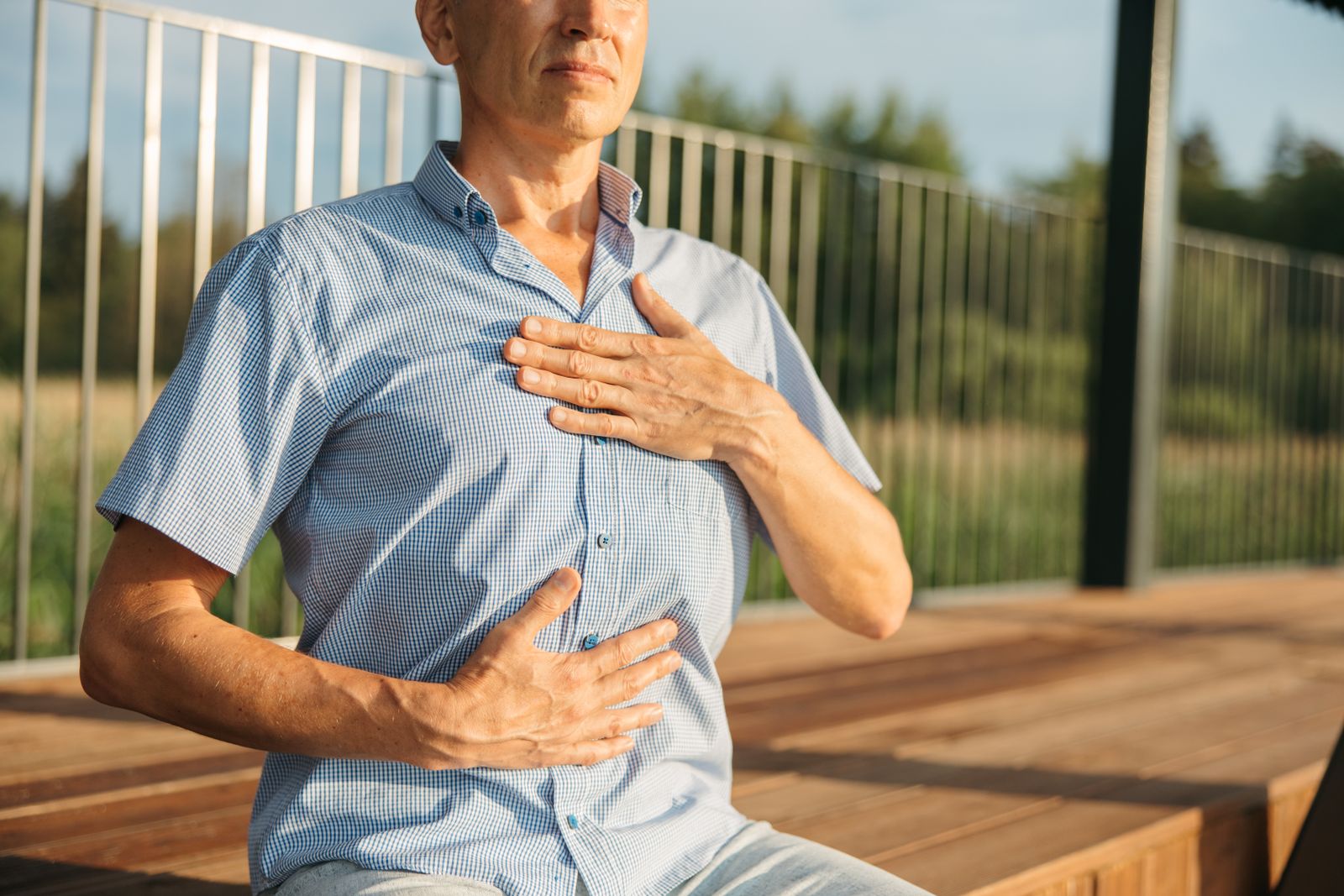
The countermeasures are simple: an active break every 60-90 minutes of desk work, with a few torso rotations and a couple of complete breaths; three 30-second checks a day, morning, midday and evening, to notice how you are breathing at that moment, and one hand on the chest and one on the abdomen, as in the opening photo, is enough to get the answer; and ten minutes of slow breathing before bed, which besides consolidating the pattern improve sleep, the other main factor the morning HRV keeps track of. For anyone spending many hours at a desk the furniture matters as well: a workstation that allows alternating sitting and standing, or at least a chair with real lumbar support, reduces the stiffness that builds up each day. It does not replace the exercises, but it stops working against them. After 6-8 weeks of these habits diaphragmatic breathing becomes the default, and switching it on in competition no longer requires conscious effort.
Why they belong together
What remains is why the three things should be trained together rather than picking one, and the reason is first of all mechanical: a stiff thoracic spine limits the excursion of the diaphragm and the ribs, and the deep breath has no room to happen; a chronically shallow breath, in turn, never asks the ribs to expand, and the stiffness stays. Working on both reverses the circle, because mobility opens space for the breath and the breath keeps the mobility in use. HRV, measured with method, shows week after week whether the system is responding to the work.
In high-level archers this integration is visible even to the naked eye: the chest expands fully on the inhale, the rotation of the draw flows over a supple spine, the breathing rhythm is identical arrow after arrow. It is not the result of three separate programs but of a single system, in which motor control and autonomic regulation work in the same structure. That is why this article treats the three subjects on one page.
The limits should be stated as well: work on mobility, breath and HRV does not fix flawed technique, does not replace arrow volume and is not therapy, because real shoulder or back pain requires a professional assessment, not a foam roller. And it is slow by nature; its effects are judged over months, not weeks.
With a few months of regular practice, what can reasonably be expected is better technical consistency, a steadier handling of competition pressure and a set of benefits that extend beyond the range: posture, neck tension that eases, sleep. None of the three tracks requires equipment, a dedicated coach or more than a quarter of an hour a day; they require regularity, which is the hard part.
The questions I get asked most
What is thoracic mobility for in archery?
The draw asks the torso to rotate against the pelvis by a few tens of degrees. If the thoracic spine is stiff, that rotation gets paid for by the pelvis, the shoulders or the lower back, and the stability of the shot pays with them. Gains of 5-10 degrees are enough to change the biomechanics of the movement measurably.
How do you learn diaphragmatic breathing?
With deliberate practice away from the bow: 8-12 minutes a day, seated or lying down, one hand on the chest and one on the abdomen to check that the lower one moves first. The rhythm the research converges on is slow, around six breaths per minute. After 4-6 weeks the pattern starts coming on its own.
What does HRV measure and how do you use it in practice?
It measures the variability of the time between heartbeats, which reflects the work of the parasympathetic brake. In practice: RMSSD in the morning right after waking, 2-5 minutes under the same conditions, spontaneous breathing, and you compare the value with your own seven-day average. A drop of more than 20% suggests a lighter day.
Does slow breathing really raise HRV?
Yes, in two different senses that must be kept apart. While you practice it, HRV rises by definition: at six breaths per minute the heart's oscillation is at its widest. As a training effect, regular practice also tends to lift baseline values over weeks, by an amount that varies from person to person. For the morning measurement, though, you breathe spontaneously: otherwise you are measuring the exercise, not yourself.
Further reading. What you read here rests on the scientific literature. To keep the text light I do not cite individual studies, but you can find the full reference library, over 120 studies and texts, on the dedicated page.
Go to the bibliographySome things I take on directly.
I work on training and functional rehabilitation, on injury prevention and recovery, and on research. If you have a project or a collaboration in mind, or a question left over from what you have just read, write to me: I answer myself.