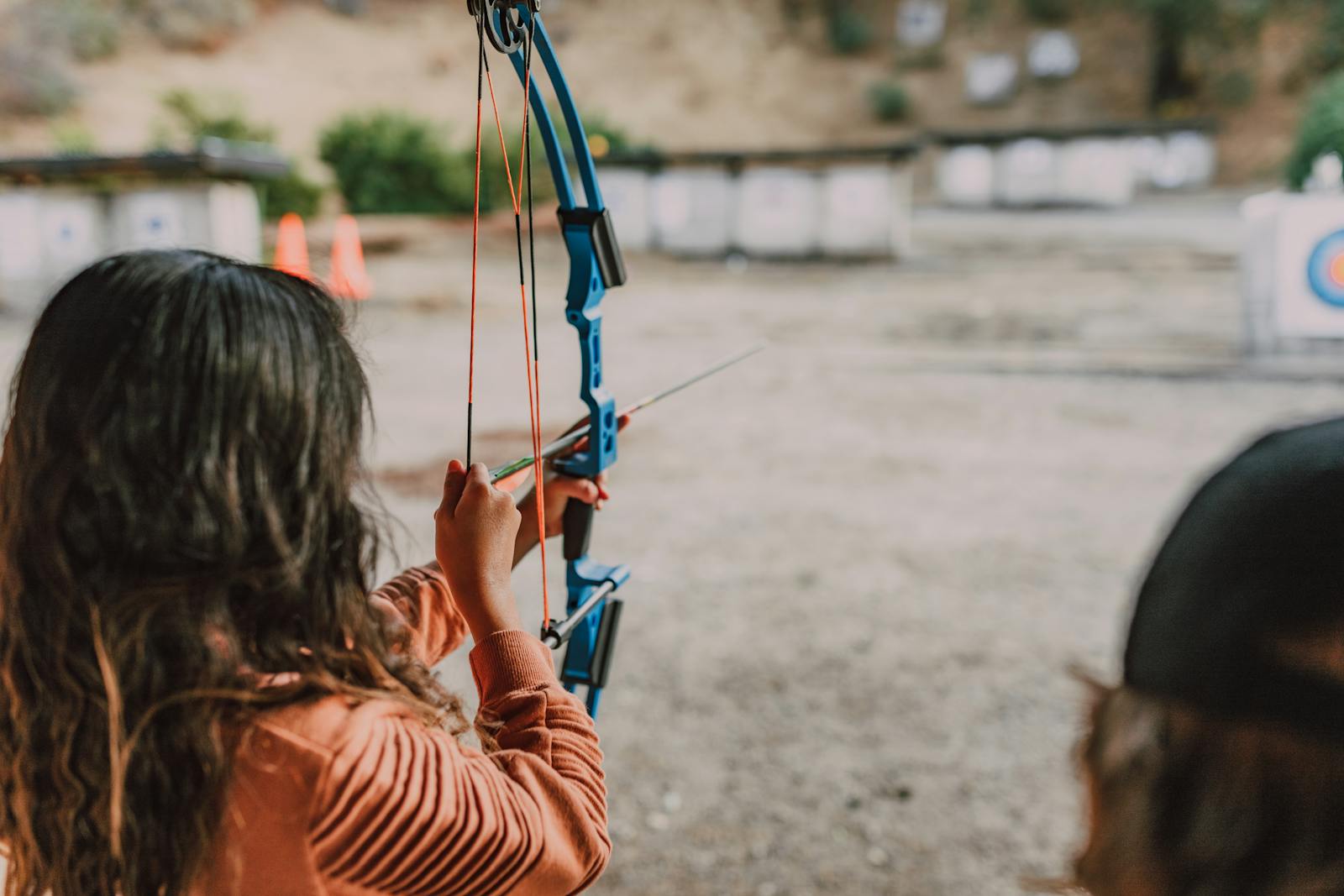
Part of the complete guide: How to improve your archery score
A working routine has four elements: an identical anchor point, structured breathing, a quiet eye of about two seconds on the gold, and an action cue like back, not an outcome word. Duration runs 6 to 10 seconds in recurve, 4 to 8 in compound, 3 to 6 for instinctive, but holding it within half a second arrow to arrow matters more than the number. Cut superstitious gestures and checklists, and never lengthen it mid-competition.
The pre-shot routine is the fixed sequence of physical, visual, respiratory, and mental actions that an archer repeats in the 6-15 seconds before the release. It is one of the most reliable markers of mastery: elite archers hold routines that last almost exactly the same duration from one arrow to the next, intermediate archers show far more variation, and beginners often have no real routine at all.
Research on the pre-shot routine in precision sports, archery, target shooting, golf, and basketball free throws, is extensive and converges on a handful of solid principles. This article examines what makes a routine work, which elements are non-negotiable, which ones to cut, how long it should last, and how to build one from scratch in eight weeks.
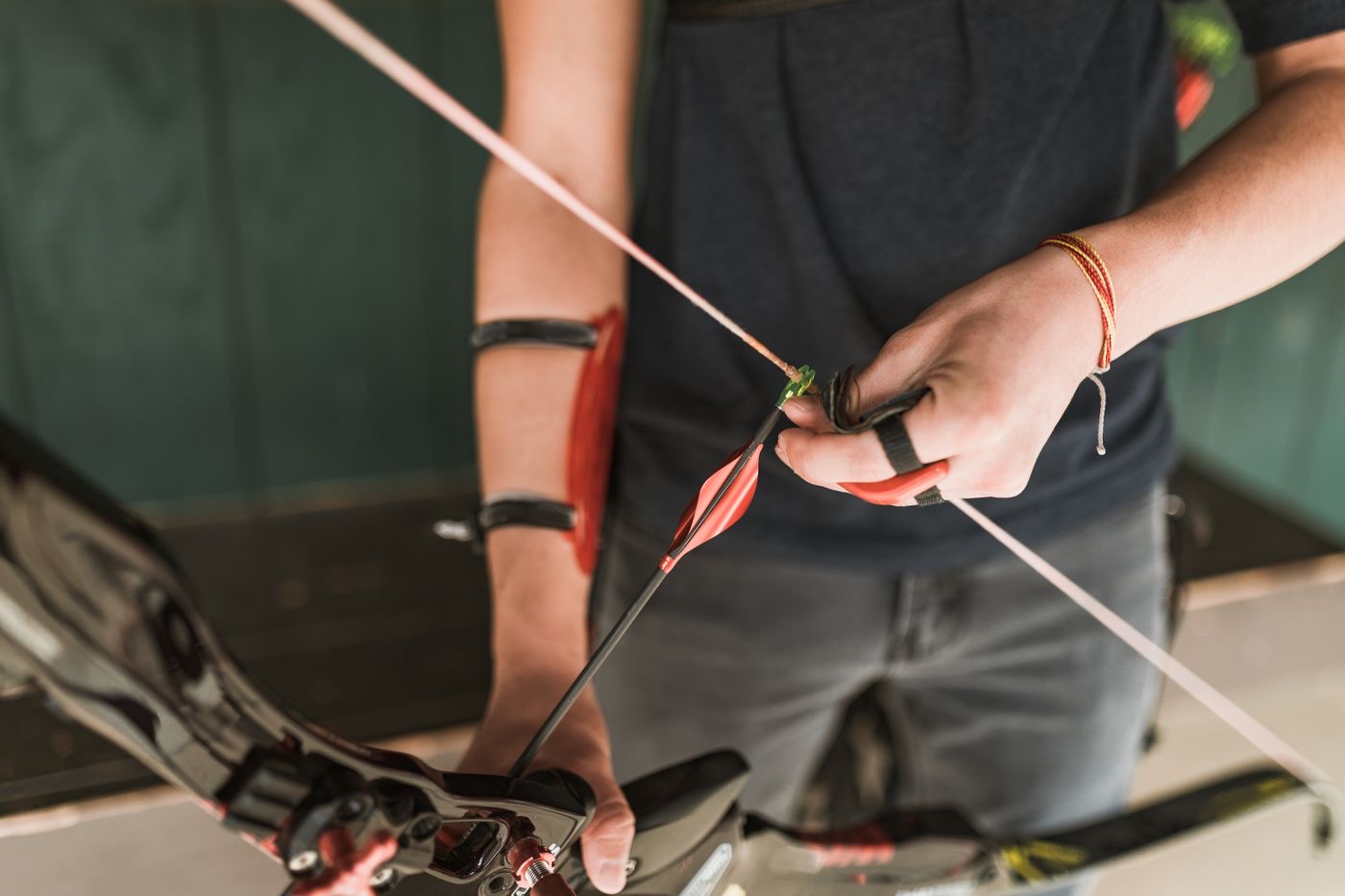
Why a pre-shot routine works
The neural mechanism is straightforward: a consistent routine, repeated thousands of times, becomes a conditioned anchor, in which each action recalls the physical and mental state you have associated with it. After a few hundred repetitions, simply beginning the routine is enough to bring on the slowed heart rate, parasympathetic calm, and focus that a clean shot requires.
This is exactly why the routine becomes most valuable in competition, when the context shifts and crowd, stakes, wind and travel pull you away from your optimal state. The routine, identical to the one you have performed thousands of times in training, returns you to the right starting point, whatever is happening around you.
There is a second effect: it frees up attention. An automatic routine releases cognitive bandwidth that you can redirect toward aiming and reading the conditions. Without a routine every arrow forces you to decide everything again from scratch, when to breathe, how long to look, when to release, and every decision consumes attention and adds variability.
The non-negotiable elements of a well-built routine
Not all routines are equal: the ones that actually work contain certain elements that research has identified as decisive, and without them the routine becomes little more than a superstitious ritual, comfortable to perform but without effect on the score.
Each of these four elements has its own neurophysiological rationale: the anchor point calibrates the starting geometry, breathing modulates arousal, quiet eye activates the visuomotor circuits and signals to the system that the program is ready, while the mental cue acts as the trigger that initiates automatic execution.
How long a pre-shot routine should last
The right duration varies by division: in Olympic recurve it is typically 6-10 seconds, from the raise through the anchor point to the release, while in compound it shortens to 4-8 seconds because of the mechanical trigger. In instinctive shooting it drops further, to 3-6 seconds, with more weight on the visual component than on breathing.
But more important than the duration itself is consistency: a routine held within ±0.5 seconds on every arrow is worth far more than one that wavers by ±2 seconds. Temporal regularity is one of the most reliable markers of mastery, not the number itself.
When you time archers of different levels, routine duration is far more regular in elite archers than in intermediate ones: it is one of the clearest differences in temporal consistency between those who shoot well and those who do not yet. On its own it does not decide the score, but it is one of the many building blocks that, added together, make the difference in competition.
What to cut from the routine
Many archers build routines cluttered with elements that feel useful but actually work against them, which makes choosing what to remove as important as choosing what to include.
Evaluative self-talk
Phrases such as don't miss, I need a ten, watch the wind are evaluative or avoidant. They increase sympathetic activation and degrade the fluency of the movement.
Replace them with action-oriented cues (expand, back, centre) anchored to the movement rather than the outcome. The brain responds better to positively framed instructions.
Long mental checklists
Mentally running through posture, anchor point, expansion, aim, and release as a five-item checklist overloads the prefrontal cortex and inhibits motor automation.
The routine should be simple: two or three cues at most, each brief. Everything else must be automated through practice.
Superstitious movements
Touching a jacket button, adjusting glasses, cracking the neck. These gestures create an illusion of control but increase temporal variability in the routine.
Cut anything without a documented technical rationale. A clean routine is almost always more effective than a ritualistic one.
In-competition variations
Adding elements to the routine during competition (an extra breath because of nerves, a double-check because something feels off) degrades it rather than reinforcing it.
The routine must be executed identically regardless of context. If it is not working, revise it in training. Never modify it during a competition.
How to build your routine in 8 weeks
A routine that works is not improvised: it is built through an orderly process, and eight weeks is the minimum time needed to make it automatic. As always, skipping steps may shorten the timeline on paper while lengthening it in practice.
Three examples of well-built routines
To make these principles concrete, here are three examples of routines used by high-level archers. These are not prescriptions but reference points for understanding how the elements combine in practice.
8-second sequence
Sec 0-2: Anchor point (hand to face, nose-to-string contact).
Sec 2-4: Exhale + begin scapular expansion.
Sec 4-6: Quiet eye on the gold, mental cue: back.
Sec 6-8: Clicker drops, passive release within 0.3 seconds.
Target tolerance ±0.5 seconds. The cue "back" directs attention to expansion, not to the release.
5-second sequence
Sec 0-1: Draw to the wall, anchor point below the ear.
Sec 1-2: Short breath in, level check.
Sec 2-4: Quiet eye fixed on the gold, cue: colour.
Sec 4-5: Progressive trigger pressure until the release fires.
Shorter routine to suit the mechanical nature of the release. The colour cue focuses visual attention on the target.
4-second sequence
Sec 0-1: Posture, shoulder-hip-foot alignment.
Sec 1-2: Fluid draw, light anchor point.
Sec 2-3: Single visual focus on the intended point of impact.
Sec 3-4: Fluid release without an explicit aiming pause.
Compressed routine for instinctive shooting, where aiming is unconscious. Greater emphasis on the visuomotor component.
Maintaining the routine over time
A routine, once built, does not stay good on its own: without maintenance it drifts, because small variations accumulate until the original structure is lost. Three habits keep it in shape.
The first is a video review every three months: you record 24 arrows under normal conditions and compare the timing and sequence against your baseline, and if the average duration has shifted by more than half a second, or if variability has increased, a targeted consolidation cycle is due.
The second is recovery after a break, because after any enforced stop, injury, holidays, exams, the routine loses its regularity: the first two or three sessions back should be devoted to recovering its timing, not to building arrow volume.
The third is adaptation to difficult conditions, given that the baseline routine is calibrated for neutral weather: competition in strong wind, sharp cold, or at unfamiliar distances may require micro-adjustments, and these must be developed and tested in training, never improvised on competition day.
Three common problems in the pre-shot routine
Even with good intentions and a sound structure certain problems recur, and recognising them early helps you intervene before the routine deteriorates to the point of being useless.
Routine that stretches in competition
In competition many archers tend to extend their routine by 2-4 seconds compared to training, feeling they need more time to feel ready.
The result is almost always worse performance: the aim drags on, the bow arm fatigues, attention fragments. Keeping a consistent duration matters more than feeling subjectively ready.
Mental cue that shifts
Under pressure the mental cue tends to change: "back" becomes "now", "expand" becomes "centre". An evaluative or outcome-oriented cue slips in to replace the action-oriented one.
Noticing it is the first step. Returning the cue to its original form requires deliberate practice under simulated competition conditions.
Identical routine even after errors
Paradoxically, the opposite error also occurs: the routine runs unchanged even after a seven or eight, when a brief micro-reset would help (an extra breath, lowering the bow before nocking again).
The main routine stays the same, but the pre-routine phase can include an active reset after a clear error.
These three problems are natural and show up in archers at every level, so they are not signs of failure but part of the consolidation process. What makes the difference is the ability to spot them early and address them before they become stable habits.
Transferability: from training to competition
The real test of a routine is not how well it looks on the practice range but how well it holds under competition pressure. Many archers build elegant routines in training that collapse at the first qualifier that matters. Understanding why this happens, and how to prevent it, is the key to making the routine genuinely useful.
The underlying principle is that you always learn in a context. A routine built only in quiet conditions, familiar range, alone, no time pressure, stays bound to that context, so much so that changing the setting (new venue, crowd, stopwatch) is enough to weaken its recall. To make it robust, the routine must be exposed gradually to different contexts during the building process.
The protocol consists of adding pressure incrementally over the final four weeks: in week 5 you shoot with a visible clock, in week 6 scores are announced aloud after each end, in week 7 someone watches, and in week 8 you run a full competition simulation with cumulative scoring, a simulated audience and time pressure. If the routine holds under those conditions, it holds in competition too.
One caution: transfer is never perfect, because expecting the routine in competition to be identical to the one on the practice range is unrealistic, and a little more variability under pressure is normal even among elite archers. The goal is not perfection but robustness: a routine that remains recognisable and functional even when the context puts it under strain.
A useful closing habit is the post-competition debrief: in the 24-48 hours after the event, trace through how the routine held in each phase, where it stayed solid, where it broke down, which parts you skipped or shortened. This is one of the most powerful tools for improving it over time, because without it the same errors tend to repeat from one competition to the next, never fully corrected.
The pre-shot routine is the archer's technical signature.
On its own the routine does not explain most of your score, but it is one of the few things in performance that depend entirely on you: you can build it from scratch in eight weeks with a modest amount of discipline, and it gives you a stable base to build everything else on.
Further reading. What you read here rests on the scientific literature. To keep the text readable I do not cite individual studies inline, but you will find the full reference list, over 120 studies and books, on the dedicated page.
Go to the bibliographySome things I take on directly.
I work on training and functional rehabilitation, on injury prevention and recovery, and on research. If you have a project or a collaboration in mind, or a question left over from what you have just read, write to me: I answer myself.