Part of the complete guide: How to improve your archery score
The centre of pressure never stops moving at full draw: the smaller its area during holding, the higher the average score, and lateral sway costs far more than front-to-back movement. Experienced archers also pre-activate: within about a hundred milliseconds before release the deep core fires, the shoulder girdle co-activates, and the string-hand flexors let go gradually. Ten minutes daily beats an hour weekly, and 6 to 12 week programmes shift COP and competition scores.
Seen from the outside, an archer holding at full draw looks like a statue, but it is an illusion: the human body, even in positions that appear most still, is never truly motionless, because at every instant dozens of muscles switch on and off to compensate for micro-oscillations in the centre of mass. In archery, where the release demands sub-millimetre precision, the quality of that invisible balance is precisely what determines the score.
Over the past twenty years, biomechanics has developed tools capable of measuring exactly what the body does during the holding phase: that moment when the string is at the anchor point, the sight is aligned, and the release is a matter of fractions of a second. What has emerged is a coherent picture in which certain indicators prove to be reliable predictors of performance. This article covers them one by one: how they are measured, what they mean, and how they are actually trained.
The thread is straightforward: posture is a living system, one that can be trained, measured and refined over time, rather than a static quality you learn once and put away. The more you understand its complexity, the clearer it becomes why some archers look like rocks while others sway almost imperceptibly, and why that difference always ends up on the target face.
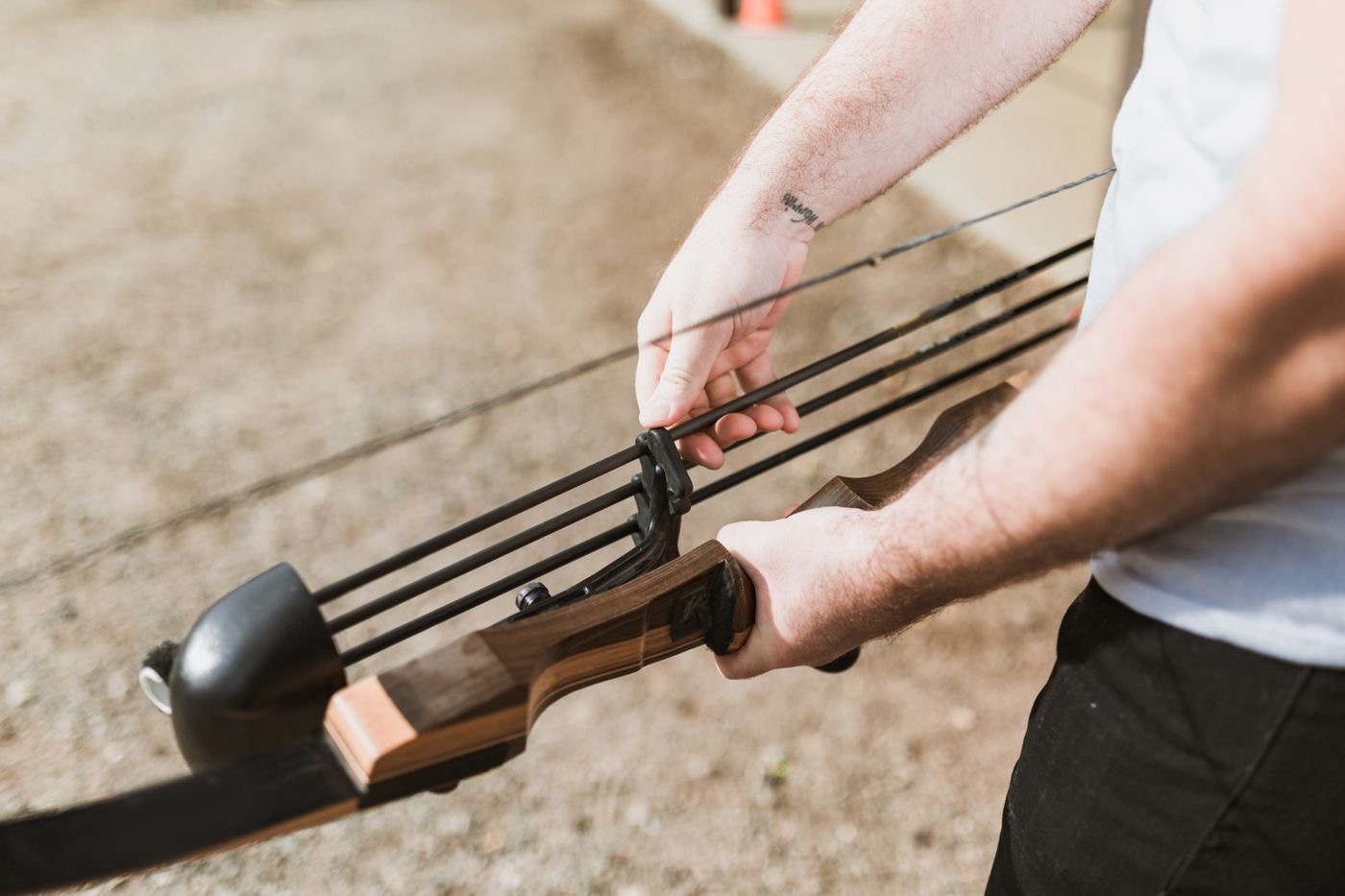
The centre of pressure: the archer's postural signature
The centre of pressure, or COP, is the point at which the body's pressure is transferred to the ground. It is measured with a force platform, and what the data reveal is that it oscillates continuously in two directions: side to side (medio-lateral) and front to back (antero-posterior). How large those oscillations are in the seconds before the release is one of the most studied indicators of an archer's stability.
Archery research converges on three points. First: the area the COP traces during the holding phase is inversely related to score, the smaller the area, the higher the average score. Second: COP velocity, meaning how many millimetres per second it travels, differentiates levels even more clearly and is often more sensitive than area in detecting subtle differences. Third: it is lateral sway that carries the most weight, far more than front-to-back movement. In other words, side-to-side oscillation is costly.
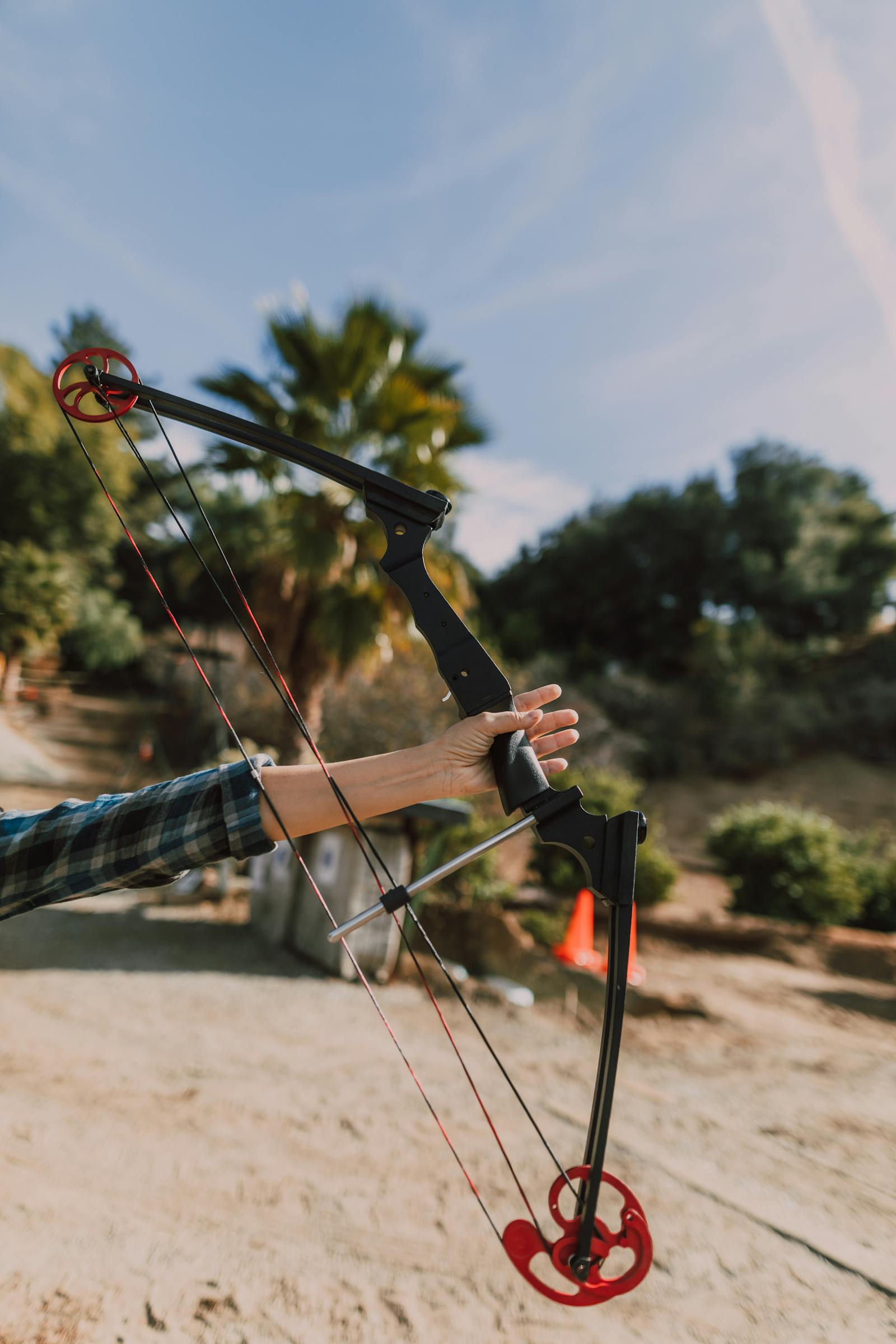
Between an elite archer and an intermediate, at the same aiming duration, the COP area can be several times larger. And this is not a matter of "staying still" in the ordinary sense: it is about how the postural system manages the instability that is already inherent in the shot, holding a bow with 18-22 kg of draw weight on one arm while the other pushes in the opposite direction. That is dynamic equilibrium, not a pose.
There is another aspect of COP that almost no one considers: its arrow-to-arrow variability. An archer may have an acceptable average area but enormous variance, some arrows rock-steady, others with oscillations two or three times larger. This variability is invisible to the naked eye, and often to the archer as well, yet it is one of the most reliable signals that the postural system is not yet consolidated. In many cases, working to make it consistent matters more than working to make it, on average, smaller.
Anticipatory postural adjustments
A more recent finding, and one of the most compelling, concerns what happens before the release. Neuroscience has documented a phenomenon called the anticipatory postural adjustment (APA): in the window preceding a voluntary movement, roughly within a hundred milliseconds, the nervous system pre-activates certain postural muscles to stabilise the body in advance, before the movement even begins.
In experienced archers, these adjustments follow a precise pattern: the core, particularly the multifidus and transversus abdominis, pre-activates with an intensity that remains consistent from one arrow to the next, while the shoulder girdle, lower trapezius and serratus anterior, enters a balanced co-activation within the last tenth of a second before the release itself. And the string-hand flexors deactivate gradually, without a sudden jerk or a delayed let-off.
In intermediate archers, by contrast, this sequence is fragmented: it exists, but it changes from shot to shot, sometimes well synchronised, other times off-tempo. The practical result is that the body stabilises after the release rather than anticipating it. A fraction of a second that, multiplied across 70 arrows in a competition, eventually adds up.
The most important point, though, is this: these adjustments are not developed simply by shooting more. They arise from neural integration that requires targeted stimuli, pre-activation exercises, electromyographic feedback when available, and above all the solid foundations of strength, mobility, and breathing control on which the nervous system can build stable patterns. They cannot be taught through instruction alone: you create the conditions for them to emerge on their own.
The release does not begin with the release.
When you work on release consistency, you are in fact training the body's preparation in the fractions of a second that precede it. What you see at the moment of release is only the final output of a process already completed. Shifting perspective from reactive to anticipatory is one of the most significant conceptual steps for intermediate archers.
The muscle chains of stability
Stability in archery does not depend on a single muscle but on coordinated kinematic chains that work together, and the evidence converges on three main chains, each with a specific role and key muscles that can be measured through surface EMG (sEMG).
Deep posterior
Multifidus, spinal erectors, lower trapezius, infraspinatus.
This chain maintains spinal verticality under the asymmetric load of the bow. Its early and symmetrical activation predicts trunk stability during the holding phase.
Scapular
Lower and middle trapezius, rhomboids, serratus anterior.
Anchors the scapula to the thorax, preventing it from winging outward under draw. Weakness here is one of the most common patterns in recreational archers and one of the most frequent causes of shoulder pain over time.
Bow arm
Middle deltoid, brachioradialis, wrist extensors, intrinsic hand muscles.
Maintains steady tension without co-activating the antagonists (biceps, flexors). When it over-tightens, the bow arm begins to tremble and the sight picture oscillates visibly.
The three chains do not work in isolation: they communicate continuously, and a weakness in one creates compensations in the others. For example, a weak deep posterior chain forces the scapular chain to overload, which in turn reduces the quality of work available to the bow arm. Integrated assessment of all three is therefore more informative than evaluating any single chain alone.
An important clinical note: assessment of these chains is not the territory of a shooting coach, but of professionals with specific training in exercise science, physiotherapy, or functional biomechanics. A thorough postural analysis requires both qualitative observation and instruments, force platforms, video, and functional tests, that go well beyond what a shooting range can provide.
Breathing as a postural strategy
One aspect almost always overlooked when discussing stability is breathing: elite archers tend to time the release to a precise point in the respiratory cycle, usually at the end of a controlled exhalation, or in a brief breath-hold after exhaling. This is not a stylistic quirk, because during exhalation the diaphragm relaxes, intrathoracic pressure drops, and the rib cage stabilises on its own.
The same pattern is observed in other precision sports, from rifle shooting to biathlon. The optimal release window is narrow, and the best athletes find it through repetition, without being able to articulate exactly what they are doing. For an intermediate archer, however, working on it deliberately can produce rapid results: two or three weeks of targeted exercises are often enough to change the pattern.
There are essentially three main approaches: releasing at the end of a full exhalation, releasing in a brief breath-hold after a partial exhale, or releasing in the final third of a slow and controlled exhalation. Each involves trade-offs: the first gives maximum diaphragmatic stability, the second allows more time for aiming, whereas the third feels most natural but demands greater control. In the end, the archer tries all three and keeps whichever fits most cleanly into their shot sequence.
How postural stability is assessed in practice
A thorough postural assessment operates on three levels. There is the structural level: how the body is organised at rest, joint mobility ranges, and whether any asymmetries warrant further investigation. There is the functional level: isometric strength tests, endurance holds, and movement control under load. And there is the kinematic level: COP measurement, video analysis of the shot, and electromyography where needed to examine activation patterns.
Not everything requires expensive equipment: the first two levels can be done very well with limited tools and a trained eye, whereas the third requires technology or a specialised facility. The point, though, is that in most cases the first two levels are already sufficient to identify where intervention is worthwhile.
The mistake I see most often is jumping straight to the kinematic level without completing the other two. You end up measuring COP and electromyography on an athlete who has gross structural limitations that were never identified, and you get data that can be interpreted ten different ways without pointing to any clear intervention. The correct order is the reverse: structural first, then functional, kinematic last. It is slower, but it is the only sequence that holds.
How stability is trained
Certain training principles for stability appear consistently across precision sports, and they are worth laying out one at a time.
Structured programmes of 6-12 weeks produce measurable effects on COP, on lower trapezius activation, and, what matters most, on average competition scores. But the real lesson is different: there are no shortcuts. Stability is the product of hundreds of hours of quiet work done away from the range, work that shows nothing on the target face until, one day, it shows everything. One afternoon's workshop will not get you there, because that stability is infrastructure, and infrastructure is built over time.
Common errors in postural training
In practice, certain errors recur predictably and deserve to be named clearly.
Training only the large muscles
Focusing training on the visible muscles (lats, deltoids) while neglecting the small scapular stabilisers and deep core.
The result is an archer who appears strong but oscillates the moment fatigue enters the picture. Strength does not replace fine motor coordination.
Volume without specificity
Performing many repetitions of generic exercises (standard planks, squats) without replicating archery-specific postures.
This builds a useful general physical base, but with limited transfer to archery performance. It does not mirror the actual movement.
Skipping mobility work
Training strength while neglecting mobility, particularly thoracic, shoulder, and hip mobility.
A stiff spine or a restricted shoulder forces the body into compensations that undermine stability. Without mobility, strength becomes rigidity.
These three errors are not mutually exclusive: they often appear together. The good news is that they can be corrected with a few weeks of targeted work once they have been identified. The difficult part is that many archers discover them only after years of performance plateaus, at which point a late diagnosis requires dismantling well-established habits.
Beyond stability: integration with the other levers
One thing worth saying clearly: stability, as important as it is, is not sufficient on its own. An archer who is rock-steady but whose gaze has nowhere to go remains limited; one who is stable, with good quiet eye, but with haphazard periodisation will arrive at competition in form one day and flat the next. Performance comes from the interplay of multiple systems, never from excellence in just one.
That said, stability is probably the foundation on which all the other levers rest. Without a solid postural base, work on gaze control struggles to bear fruit, because the sight picture moves for mechanical reasons before attention even enters the equation. And without stability, an inconsistent release is a consequence more than a cause. This is why, in an initial assessment, posture is almost always the first thing I look at: not because it is the most important factor in absolute terms, but because it shapes everything else.
The practical takeaway is straightforward: if you are an intermediate archer who has been stuck for months, before changing your bow, arrows, anchor point or style, stop and ask what your body is doing in the three seconds before the release, because in most cases the answer to that question alone explains a large part of the problem. The rest are details.
Further reading. What you read here rests on the scientific literature. To keep the text readable I do not cite individual studies inline, but you will find the full reference list, over 120 studies and books, on the dedicated page.
Go to the bibliographySome things I take on directly.
I work on training and functional rehabilitation, on injury prevention and recovery, and on research. If you have a project or a collaboration in mind, or a question left over from what you have just read, write to me: I answer myself.