Part of the complete guide: How to improve your archery score
Indoor at 18 metres and outdoor at 70 are nearly two sports: the indoor ten ring is 8 centimetres against 12 outdoors, and flight time rises from about 0.3 seconds to 1.1 to 1.3. Indoor rewards fine consistency and a tight cadence, and lets recurve archers drop poundage slightly; outdoor rewards technical endurance across 144 arrows and the ability to read wind. Each transition needs two to three weeks of adaptation and a real break.
The Italian archery competition calendar revolves around two main seasons: indoor (typically October to March, competitions at 18 metres in enclosed venues) and outdoor (April to September, competitions at 70 metres in open air). For competitive archers, the two seasons pose technical and mental challenges that differ in meaningful ways, and each calls for specific adaptations in preparation and execution.
Many intermediate archers treat the two disciplines as essentially the same, applying one approach to both, with the result that they underperform in both. Recognising the specific demands of each and calibrating your preparation accordingly is one of those shifts in awareness that separate the intermediate archer from the advanced one.
This article covers the core differences between indoor and outdoor, the technical adaptations specific to each, the mental side of managing both, equipment considerations, and how to organise your annual calendar to get the most out of each season.
The fundamental differences
These are differences that run deep, affecting technique, equipment, mindset and preparation, and understanding them is the first step toward optimising each discipline on its own terms.
Indoor-specific technique
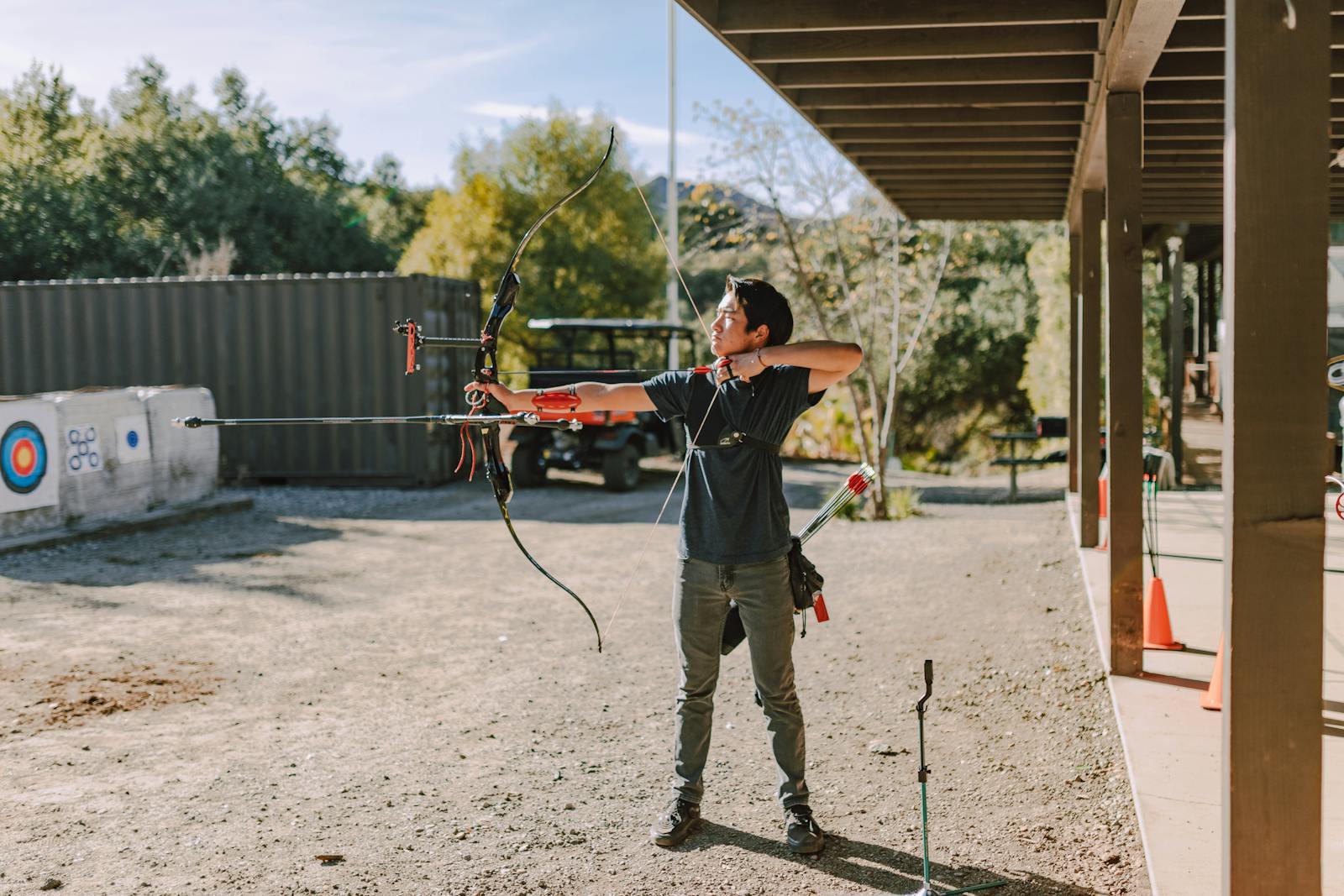
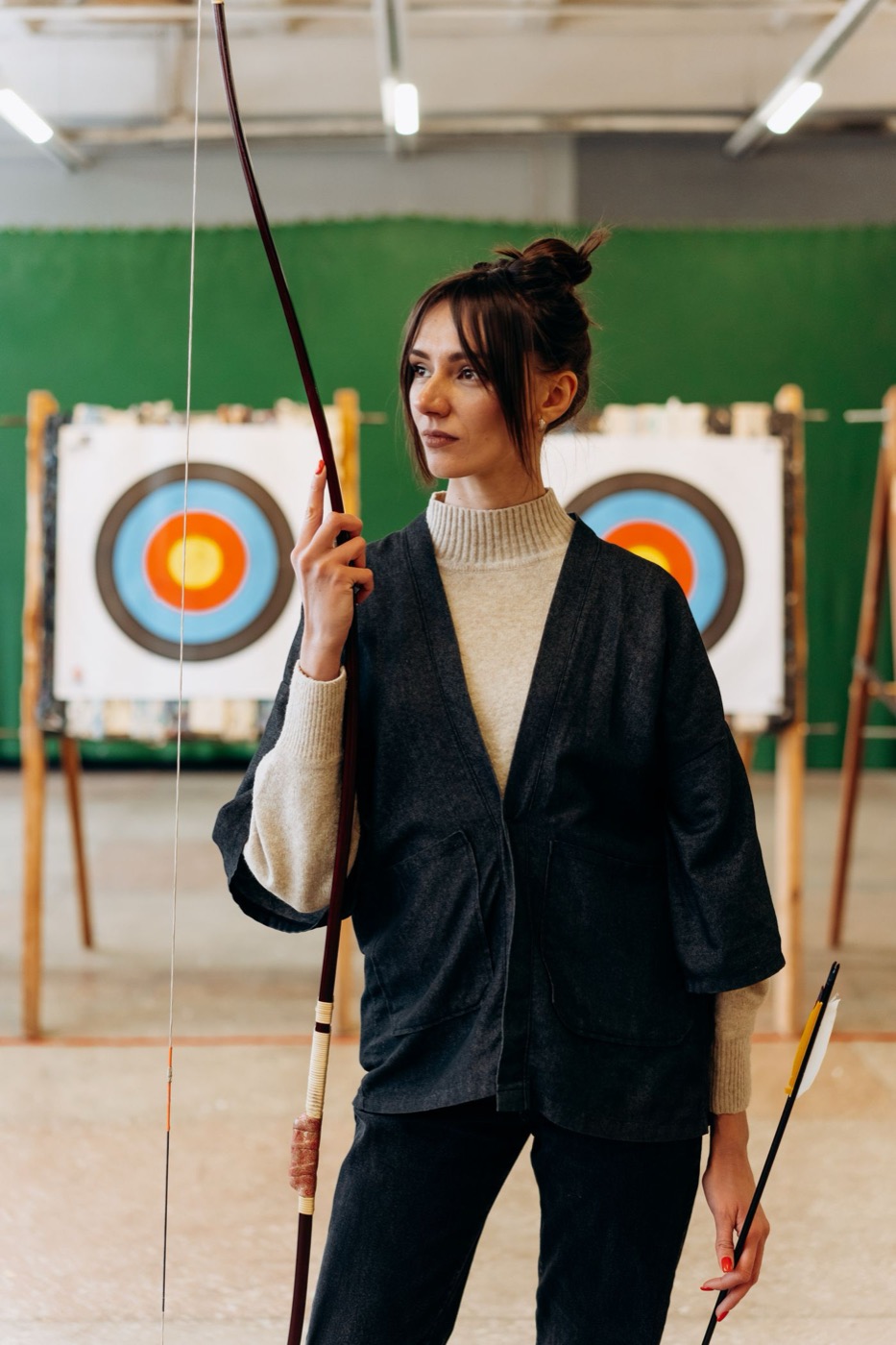
Indoor at 18 metres rewards maximum group precision more than extended technical endurance. The small Spot target (40cm, with the 10 ring in a circle just 8cm across) leaves very little margin: a slight lateral deviation in the release is enough to slide from a 10 to a 9.
Technically, indoor demands consistent anchoring above all, since at 18 metres millimetres genuinely matter, a slightly faster pre-shot routine, because arrow cadence tends to be higher, and careful attention to a clean release, given how little flight distance there is to absorb imperfection, all inside a tight competition rhythm managed with few breaks.
For recurve archers, indoor often lets you bring the draw weight down slightly with no real penalty, since the short distance does not call for high arrow speed, so the physical effort is lower and that freed attention can go entirely toward fine precision. For compound, indoor is where mechanical accuracy counts most: a well-tuned setup translates directly into a competitive edge.
Outdoor-specific technique
Outdoor at 70 metres rewards technical endurance and condition management: the 122cm target forgives small errors more readily, but the long flight amplifies every imperfection in the release. An arrow that felt clean at 18 metres will still land close to centre; the same arrow at 70 metres, if the release was not clean, can end up very far off.
Technically, outdoor demands sufficient arrow speed, which means higher draw weight, and it asks you to manage wind and weather, to hold technique across 144 arrows in a full FITA day, and to read and accommodate conditions that shift mid-round.
For recurve, outdoor calls for longer stabilisers, thinner and lighter arrows, and a sight with enough adjustment range. For compound it calls for more aerodynamic arrows and more precise tuning for long-distance ballistics.
A different mental approach
Concentrated focus
Indoor demands intense concentration for a few seconds at a time, repeated many times over, with short intervals between arrows, a tight rhythm and quick decisions. The mental challenge is sustaining consistent, concentrated attention.
Useful mental training: a quick but stable pre-shot routine, the ability to reset rapidly between arrows, and managing isolated mistakes without carrying them into the next shot.
Sustained attention
Outdoor demands sustained attention over hours, with longer pauses and continuously shifting conditions. The mental challenge is staying clear-headed through the final ends of a long session.
Useful mental training: mindfulness practices for sustained attention, treating pauses strategically as recovery windows, and reading conditions actively as useful input rather than noise.
Equipment: separate setups or a hybrid
A question that comes up often is whether it is worth having two distinct setups for indoor and outdoor, or managing one hybrid setup. The answer depends on your level and how much you can invest.
For the recreational or intermediate archer, a single setup with a few small seasonal modifications is usually enough, and the typical adjustments are few: changing stabilisers (shorter for indoor, longer for outdoor), swapping the sight if you have a dual kit, and possibly the arrows (heavier for indoor, thinner for outdoor).
For the advanced competitive archer, two complete setups are the technical optimum: specific optimisation for each discipline, with no compromises. The cost is significant, effectively doubling your equipment, but for archers targeting specific placements at national championships the added technical margin justifies it.
Whatever the choice, the principle is the same: deliberate optimisation, not a setup left to chance. Even with a single bow, making considered adjustments for the two disciplines returns far more than shooting the same configuration all year.
Structuring the annual calendar
The ideal annual calendar, for competitive archers, comes from strategic planning across the two seasons rather than a haphazard sequence of events, and four phases typically organise the year.
Cross-benefits
Practising both disciplines seriously produces benefits that isolated practice cannot. Indoor consolidates fine technical consistency; outdoor develops sustained attention and the capacity to adapt. Together, they build technically more complete archers.
More specifically: indoor is a school of consistency that carries over into outdoor. Being able to execute dozens of identical arrows at 18 metres builds automatic patterns that hold up at long distances too. And the reverse is true as well: outdoor is a school of resilience that feeds back into indoor. Staying clear-headed under fatigue and adapting to hard conditions makes indoor competition, under pressure, relatively more manageable.
For the recreational archer looking to develop technically, alternating indoor and outdoor regularly, even just for the pleasure of it, produces more complete progress than committing to a single discipline. This is one reason why Italy's top-level archers are, almost without exception, strong in both.
Common mistakes in the seasonal transition
The transitions between seasons are delicate moments, and three mistakes come up often enough to be worth naming.
The first is an abrupt transition: jumping straight from indoor patterns to outdoor ones (or vice versa) without an adaptation period. The motor system needs two to three weeks of gradual transition to recalibrate to the specific demands of each discipline.
The second is technical inconsistency: changing fundamental parts of your technique right during the transition, hoping to gain something along the way. The risk is that you disrupt established patterns before new ones are fully built. Deep technical changes belong in the gaps between seasons, not in the transitions themselves.
The third is insufficient rest: running the outdoor calendar straight off the back of indoor without a genuine break, so that accumulated fatigue carries into the new season. An active rest period of two to three weeks between the two lets the body recover and start the new season with energy.
Indoor and outdoor are two sports shot with the same bow.
Approaching them with identical preparation leads to underperformance in both. Recognising the specific demands of each and calibrating your preparation accordingly is one of the most strategically important skills for any serious competitive archer.
For recreational archers
For those who shoot recreationally, without competitive ambitions, alternating indoor and outdoor still offers concrete benefits worth taking advantage of.
The main one is continuity through the year: indoor lets you keep shooting through the winter months, when weather makes outdoor impractical. Without indoor, many Italian archers would lose five to six months of practice a year, which brings technical regression and a drop in motivation.
The second is variety: alternating the two disciplines keeps interest alive, lets you explore different aspects of the sport, and breaks the monotony that can lead to dropping out. And even without competitive goals, taking part in one or two competitions per season, perhaps just at amateur club level, gives practice a structure that sustains motivation.
The third is the social dimension: indoor is often the period when clubs organise more social and educational activities. Using it to get involved in the club community builds connections that support practice even through personal difficulties.
Indoor venue characteristics
Indoor venues in Italy vary considerably in quality and features, and knowing the differences helps you choose where to train and compete, as well as keeping your own results in different venues in perspective.
The first factor is available distance: standard venues offer 18 metres as the main distance, and some extend to 25 or 30 metres for broader training options. Very few reach 50 or 70 metres indoors; these are dedicated national-level facilities that allow outdoor-style training even in winter.
The second is lighting: a good venue has diffuse, even light across both the target and the shooting line, whereas a poor one has shadows, variable illumination and reflections off glossy surfaces. Lighting quality directly affects fine aiming and the value of training sessions.
Air quality and temperature matter too: a well-managed venue maintains controlled temperature (18 to 22°C) and good air circulation, whereas a poor one can be too warm and stuffy, or too cold. In long sessions, thermal comfort has a real impact on concentration.
The last factor is shooting line capacity: larger venues allow many archers to shoot simultaneously, which is useful for simulating competition conditions in training. Smaller ones limit you instead to individual sessions, removing both the social dimension and the opportunity to get comfortable with other archers nearby.
Outdoor safety considerations
Outdoor shooting brings specific safety considerations: open-air ranges must have adequate backstops behind the targets to catch stray arrows, and sufficient lateral safety margins to prevent accidents during shooting.
For those training at a club, safety procedures are codified and generally well observed. For those training on private land, your own property or a dedicated plot, safety responsibility falls entirely on the individual, and rigorous standards are essential: adequate backstops, lateral clearance, controlled access to the shooting area, and oversight of anyone entering the range.
Statistically, archery is one of the safest sports in terms of injury to third parties, but when an accident does occur it can be serious. A culture of safety, in your club and in your personal practice, is an investment that should never be sacrificed for convenience or speed.
The evolution of the two disciplines
Indoor and outdoor have followed somewhat different historical paths, which helps explain some of their current traits. Outdoor is the original form of the sport, descended from military and hunting practice: the long distances and natural settings reflect that origin directly.
Indoor is a more recent development, created largely to allow continuous practice through the winter and to offer a competition format better suited to spectators: shorter in duration, held in a controlled environment, and easy to stage under cover. The 18-metre distance is a relatively recent standard by comparison.
This background explains why outdoor is often seen as the primary discipline for high-level archers. In its 70-metre form it is the Olympic discipline, while indoor is viewed as a complement. Yet from a technical standpoint, indoor is arguably the more demanding: the tight margins of the Spot target expose imperfections that outdoor might forgive.
For Italian archers, competing at the Italian indoor championships (February to March) and outdoor championships (September) means completing a full competitive year, one that gives proper weight to both disciplines. Many elite athletes compete at a high level in both circuits, which is evidence that exclusive specialisation is not a prerequisite for reaching the top.
Modern archery therefore offers two complementary seasons that, approached with strategy, build richer competitive careers and more complete technique than would be possible by concentrating on just one. For anyone looking to maximise their development over the medium and long term, recognising the value of both and calibrating your preparation accordingly is one of the most important choices in your progression.
One last note for those just starting out: there is no single right season to begin. You can start in autumn with indoor courses, which allow gradual learning in a controlled environment, or in spring with outdoor courses, which bring out the natural, open-air dimension of the sport. What matters is starting with a qualified instructor, and knowing that both seasons have value. Move through them both, and your practice grows richer over time.
Further reading. What you read here rests on the scientific literature. To keep the text readable I do not cite individual studies inline, but you will find the full reference list, over 120 studies and books, on the dedicated page.
Go to the bibliographySome things I take on directly.
I work on training and functional rehabilitation, on injury prevention and recovery, and on research. If you have a project or a collaboration in mind, or a question left over from what you have just read, write to me: I answer myself.