Part of the complete guide: How to improve your archery score
Archery holds a long performance plateau between roughly 35 and 55, then declines slowly, unlike sprinting or weightlifting. What really changes is recovery: 36 to 48 hours after an intense session past 50, against 18 to 24 hours at 25 to 30. Shoulder and thoracic mobility is the one genuine constraint, while emotional regulation and analytical patience improve with age. An archer over 60 shooting 28 pounds with sound technique outperforms one struggling with 36.
Archery is one of the very few disciplines in which a 60- or 70-year-old athlete competes at the highest level and sometimes beats archers young enough to be their children. It is a sport where accumulated experience, patience, and composure genuinely offset much of the physical decline that age brings. For any adult looking for a sport to practice over the long haul, it is one of the most sensible choices available.
This article brings together what research and field experience tell us about age-related physiological changes: how to adapt training accordingly, where the real limits lie beyond a certain age, and which limitations are simply myths that discourage many people from starting or continuing. The conclusion can be stated upfront: age is a variable, not a barrier, and no archer over 40 should feel excluded from serious practice.
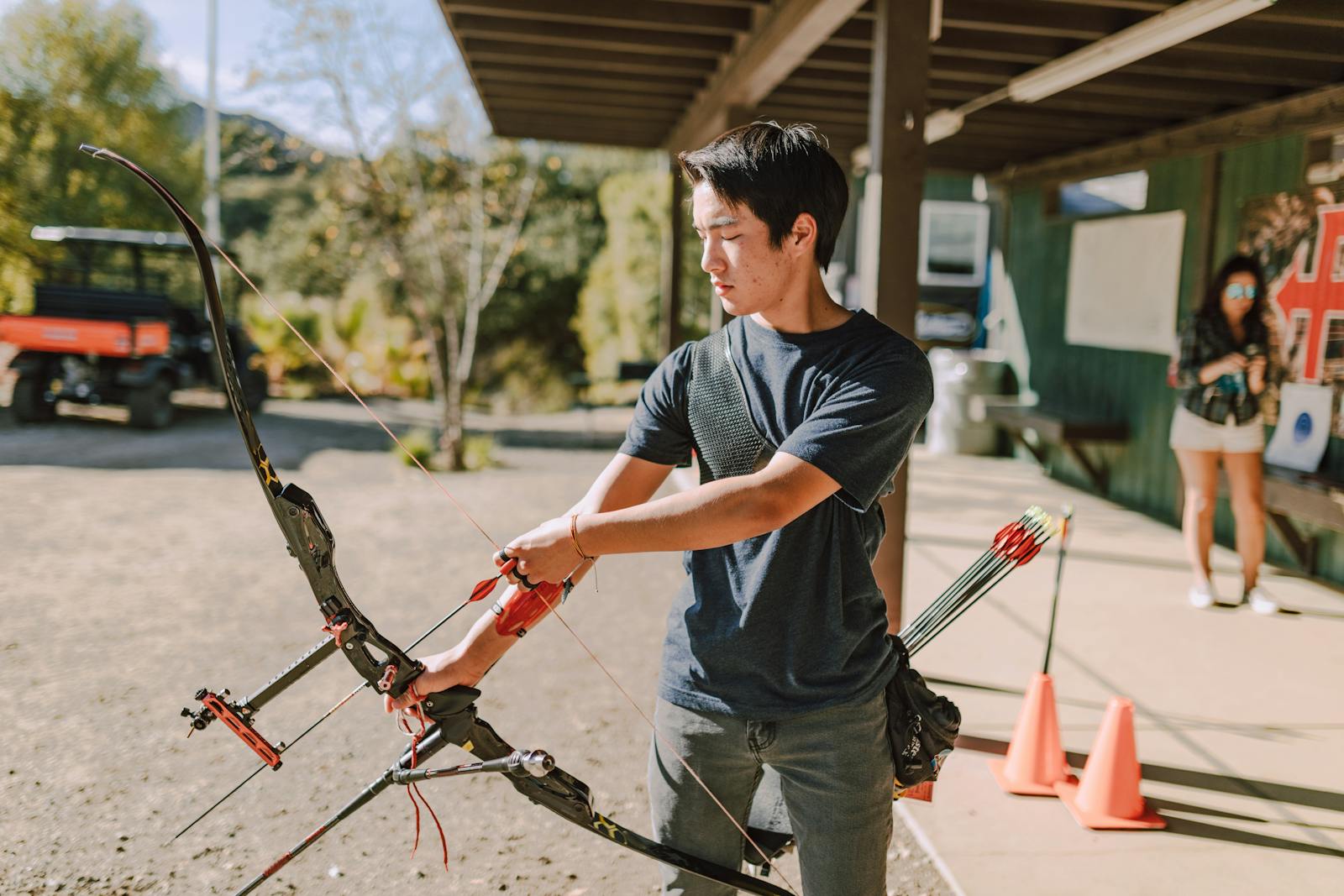
What changes physiologically with age
Ageing alters the neuromuscular system in measurable ways, and understanding those changes is useful for calibrating both physical and technical preparation to each age group, rather than applying training protocols designed for a 20-year-old body to one that, at 50, responds in an entirely different way.
Yet against these negative changes, older age brings advantages of its own, and archery, among all sports, is perhaps the one best placed to make use of them.
The specific advantages of masters archers
Where speed, power, and contact sports penalise age heavily, archery offers advantages that often more than offset those physiological changes.
Emotional stability
Emotional regulation tends to improve with age: mature adults typically handle competition anxiety better and are less easily thrown by an isolated error, staying clearer under pressure.
In a discipline where the mental game accounts for a large share of the result, this is a meaningful advantage that frequently offsets any physical constraints.
Analytical patience
Archery is a discipline that takes a long time to learn, and mature adults typically have a higher tolerance for drawn-out processes, as well as a greater capacity to work deliberately on a single detail over weeks.
Younger archers are often faster in the early stages but less consistent during consolidation phases, where adult patience tends to produce better results.
Consistent quality practice time
Many mature adults have family and work structures that allow for regular, dedicated training time, whereas younger athletes often oscillate between intense periods and forced breaks.
Consistency is one of the most important variables in archery, and the greater stability in the lives of mature adults makes it easier to build a continuous practice.
A mature analytical approach
Evaluating your own training honestly, accepting feedback, planning strategically: these are all qualities that generally improve with age and that are central to progress in archery.
Young raw talents often rely on natural ability; mature adults rely on method, which is a slower but more reliable path to excellence.
Adapting training across age groups
Both physical and technical preparation should be calibrated to age, not as a limitation to endure, but as a way to get the most out of a particular phase of life, and there are four broad age groups, each with its own characteristics and priorities.
In every one of these age groups, shooting competitively or recreationally remains entirely possible, and none of them closes the door on competition. The Italian masters championships (veterans 50 and over) have seen growing participation in recent years, and their dedicated categories specifically reward longevity in the sport.
Four myths about age in archery
Many adults give up on starting, or on continuing, because of widely held assumptions that have no scientific basis. The four most persistent ones are worth examining directly: knowing what the evidence actually says makes it easier to decide clearly.
It is too late to start at 50
The reality: a number of archers who begin as adults reach solid regional and national masters levels within a few years. The learning curve is slower than in younger athletes, and the absolute top of the sport is more accessible to those who start early, but the scope for improvement remains wide at any age.
For anyone interested in qualified recreational practice, starting at 50, 60, or even 70 produces genuinely rewarding results within a reasonable timeframe.
High draw weight is essential
The reality: the effective draw weight for performance is the one that can be sustained throughout a full session, not the maximum possible. An archer over 60 shooting 28 pounds with good technique outperforms one struggling with 36 pounds poorly managed.
Progressively reducing draw weight with age is normal and appropriate, and it has no effect on accuracy if technique remains sound.
Senior archery is purely recreational
The reality: national and international masters categories exist up to and including 80 and above. Dedicated competitions carry high technical standards and growing participation across Europe.
The competitive lifespan in archery runs from the junior categories (around 14) through to the 90-plus veterans age group. Very few sports offer this kind of range.
Experience compensates for everything
The reality: experience is valuable, but it does not compensate for a lack of physical preparation. A senior archer who neglects mobility work and rotator cuff conditioning will typically pay the price within a few years, with injuries that were preventable.
Physical preparation is non-negotiable at every age, and it becomes progressively more important as age advances.
Injury prevention at older ages
Injury risk increases with age, particularly at the shoulder, elbow, and lower back. The good news is that most of these problems are preventable, with consistent physical preparation and sensible volume management.
The most stressed structure is the rotator cuff: over time tendons degrade independently of training load and tolerate repeated stress less well, to the point that after 50 specific strengthening exercises, external rotation with a resistance band, controlled scaption, are not optional. Three to four sessions a week of ten minutes each can significantly reduce risk.
Similarly, thoracic mobility tends to decline, and a stiff thoracic spine forces the shoulder into compensatory movements that are not good for it. Five minutes a day, thoracic rotations on a foam roller, a few quadruped exercises, is a minimal investment that pays meaningful dividends over the medium term.
The third pillar is lumbar control, given that the tension of the bow arm transmits load all the way to the lower back and a weak core generates compensations that tend to become chronic over time. Anti-rotation exercises such as the Pallof press and the dead bug keep the trunk stable and prevent back problems in the long run.
Archery is a sport that can be practiced for a lifetime.
Very few sports allow you to remain competitive at 70, or to begin at 50 without an unbridgeable disadvantage. Archery rewards patience, analysis, and consistency: qualities that often sharpen with age. For anyone looking for a sport to carry through life, it is one of the most sensible choices there is.
Sustaining motivation over time
Practising archery seriously over decades means keeping motivation alive through very different phases of life, and three things more than any others help keep that drive from fading.
The first is variety, but structured variety: alternating intense and lighter periods, switching between disciplines (field, indoor, 3D) to stimulate different aspects of performance, trying competitions in different formats. Monotony is the primary enemy of long-term motivation.
The second is community: embedding practice within a network of people, training partners, a club, a federation. The social dimension is one of the strongest supports for those who continue shooting past 50; without it, many give up far sooner.
The third is redefining goals from time to time, because what drove you at 30 may leave you cold at 60. Revisiting, periodically, what you are actually looking for from archery, even if the answer changes completely, from competition to recreation, from Olympic to traditional, is what keeps the whole thing meaningful.
Medical considerations for mature archers
As the years accumulate, regular medical checks and an open conversation with your doctor about sport become increasingly important, and four areas in particular deserve attention.
The first is cardiovascular health: after 40, before taking up intense competitive activity, a cardiac evaluation including a stress ECG is advisable, even though archery is not an endurance sport. In Italy, sports medical certification for masters athletes already requires these checks by regulation.
The second is shoulder health, which is worth monitoring before problems arise. After 55, an annual orthopaedic assessment can identify rotator cuff degeneration before it becomes painful. A shoulder ultrasound is quick, non-invasive, and provides useful information for adjusting training volume.
The third is posture and the spine, where a specialist postural assessment, or a consultation with a sports physiotherapist, can identify imbalances that, left unaddressed, develop into chronic problems. Spending on these checks as prevention costs considerably less than treating a well-established issue.
The fourth is the management of existing chronic conditions. Diabetes, hypertension, and ongoing drug therapies can all alter how the body responds to training, and may require specific adaptations. The right person to advise on this is your own doctor, the only one who can place archery within the full picture of your health: no general guidance, including anything written here, can substitute for that.
Secondary benefits of archery in later life
Beyond the score, regular archery practice brings adults a range of well-documented secondary benefits: benefits that often matter more than the strictly sporting ones. Recognising them helps put the time invested in proper perspective, even on days when the arrows are not going where you want them.
The first is the maintenance of postural stability, because archery demands fine static balance and repeated postural control, and studies of older adults who practise similar disciplines show a measurable reduction in fall risk, which after 65 is one of the leading causes of serious health problems.
The second is cognitive maintenance: the attentional demands and motor planning that archery requires are, in effect, a structured mental exercise. Research on precision sports in older adults suggests a protective effect against cognitive decline, although the direct causal link is still being investigated.
The third is emotional regulation, given that the meditative quality of shooting, focused concentration, controlled breathing, arousal management, closely resembles mindfulness practice, whose benefits for anxiety and mood are well established. For many mature archers, over time, this aspect ends up mattering more than the result itself.
The fourth is quality social connection: clubs provide a stable, intergenerational social network built around regular meetings and a shared activity, and it is a documented wellbeing factor specifically for the over-55 age group, where social isolation is a risk that grows year by year.
Real profiles: archers who started after 40
To give all of this some grounding, it is worth sketching a few typical profiles of people who began archery as older adults and still went a long way. These are not exceptions: they are paths that many people can follow.
A profile that comes up frequently is the archer who starts between 45 and 50, looking for a precision sport after leaving disciplines harder on the body, running, intense cycling, football. Three years of regular, structured practice typically lead to competing at regional masters level; with five to eight serious years, national-level results become realistic. The learning curve is slower than for a 20-year-old, but the eventual standard reached is comparable.
A second profile is the former competitive archer returning after a long break: someone who shot seriously in youth, stopped for studies or family, and picks the bow up again at 50 to 60. Earlier experience accelerates the return considerably, even if the body has to be rebuilt carefully. These archers often recover their former technical level, or exceed it, within two to three years of structured practice.
A third profile is the retiree looking for a new sporting focus. Archery offers a combination that is hard to find elsewhere: moderate physical activity, continuous technical challenge, and structured social engagement. In these cases long-term motivation tends to be very high, and often produces better results than those of talented but less disciplined younger athletes.
The common thread is straightforward: in archery, time works in your favour, because it converts into patience, method and composure, all qualities that this discipline rewards generously.
Further reading. What you read here rests on the scientific literature. To keep the text readable I do not cite individual studies inline, but you will find the full reference list, over 120 studies and books, on the dedicated page.
Go to the bibliographySome things I take on directly.
I work on training and functional rehabilitation, on injury prevention and recovery, and on research. If you have a project or a collaboration in mind, or a question left over from what you have just read, write to me: I answer myself.