Part of the complete guide: How to improve your archery score
Barebow shoots from a more open stance, torso at 60 to 75 degrees, 20 to 35 pounds, and needs 12 to 24 months of proprioceptive calibration. Olympic recurve stands square at 85 to 90 degrees, 30 to 50 pounds, and commands the posterior draw synergy while suppressing the upper trapezius, reaching a basic level in 3 to 9 months. Compound peaks at 50 to 70 pounds but holds only 15 to 25, thanks to a let-off of 65 to 90%. None of the three gives precision for free.
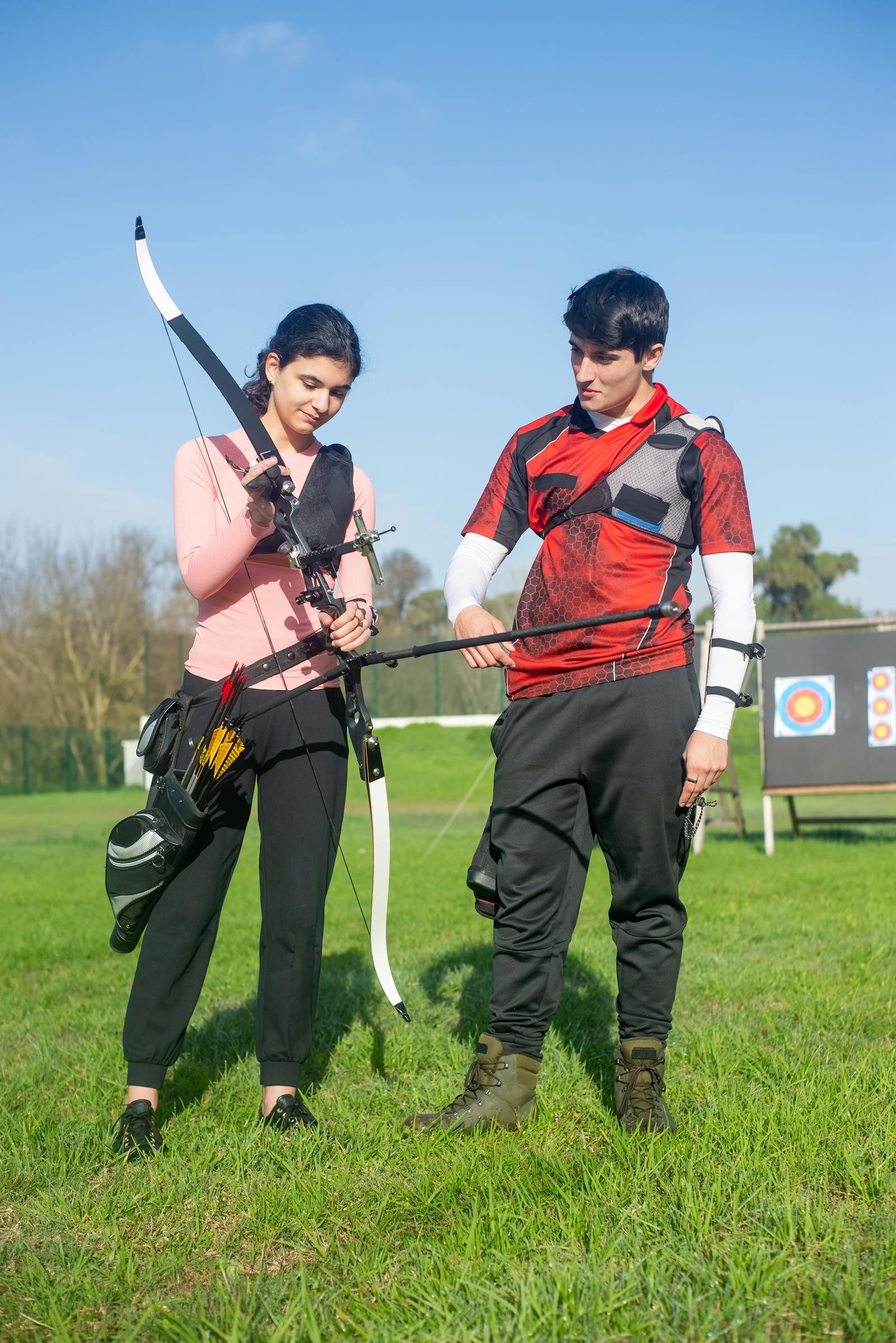
When people say archery, they are actually talking about several quite different things. That single label covers at least three main styles, with biomechanics that share relatively little: barebow / instinctive (no sight, typically shot with traditional bows such as the longbow or traditional recurve), Olympic recurve (with a sight, clicker, and stabilisers), and compound (with cams, a mechanical release aid, a peep sight, and a scope). Understanding what genuinely separates them at the level of the body is what allows you to choose the style that fits your situation, and to avoid dragging habits from one division into another where they do not work.
This article compares the three styles across what actually matters: body position, aiming system, release biomechanics, muscle activation, and learning curve. Not to argue that one is superior to the others, because no objective hierarchy exists, but to give you the foundation to choose deliberately and then practice correctly.
Body position: the foundation that differs
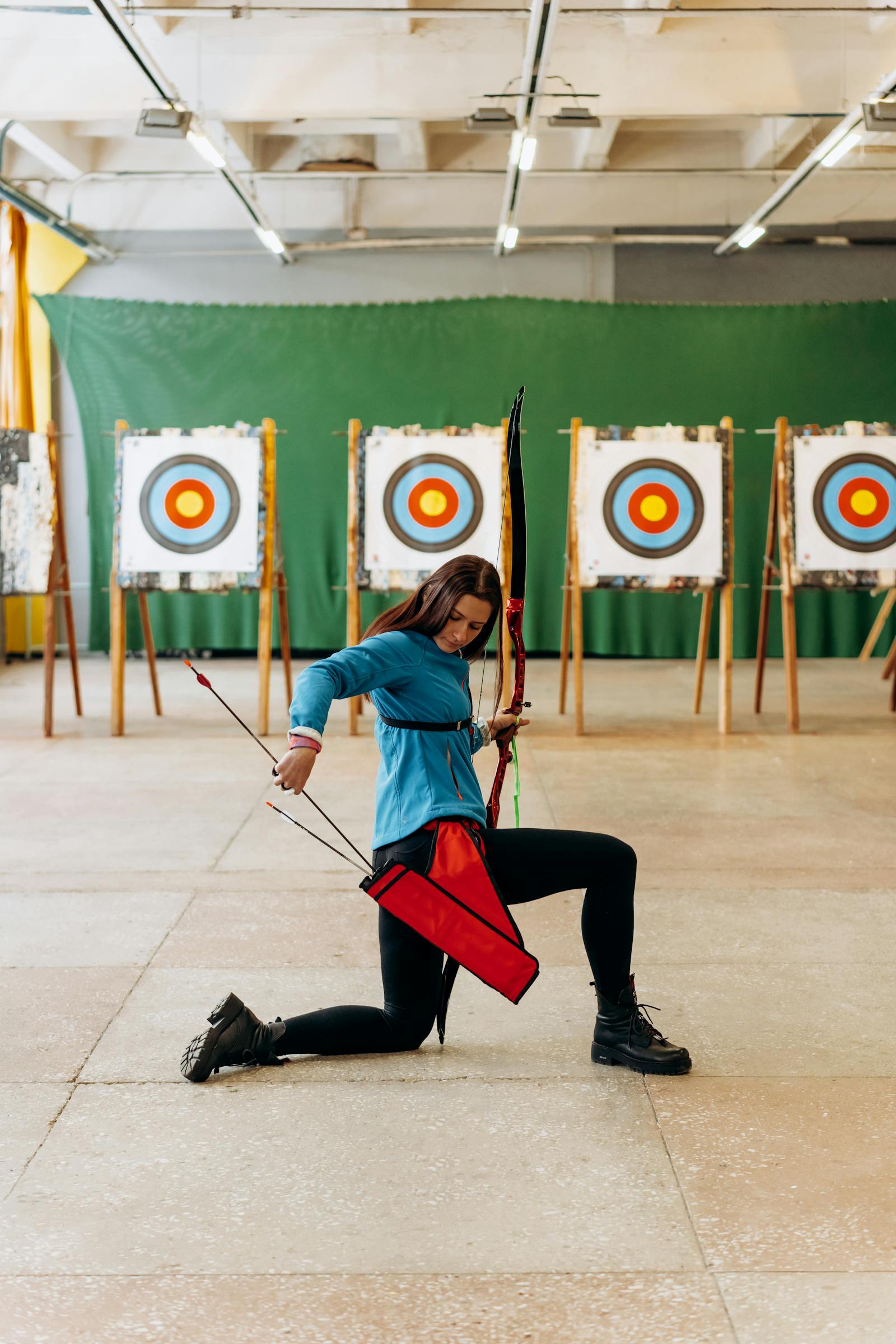
The starting position varies across the three styles in ways that are easy to miss at a glance, yet they shape everything that follows: the entire movement chain builds from how you stand.
Barebow / instinctive
Generally a more front-facing stance relative to the target, with the torso rotated 60 to 75 degrees (not the 90 degrees of Olympic recurve). The hips are more open, and weight sits slightly more on the front foot.
This posture favours mobility and adaptability: you can shoot from non-standard positions (kneeling, side-on, in motion). It reflects the hunting origins of the style.
Olympic recurve
A strict lateral stance, torso at 90 degrees to the target, feet aligned along the shooting line or slightly open. Weight distributed 50/50, hips square.
The priority is repeatability and standardized geometry. This allows the motor system to build highly consistent patterns, at the cost of contextual flexibility.
Compound
Similar to Olympic recurve but with greater tolerance for small angular variations. The torso sits at 80 to 90 degrees, though the postural rigidity required is lower thanks to the assistive devices.
The mechanical release aid and peep sight partially compensate for postural variation, making the style more forgiving for archers with mobility limitations.
Aiming system: three fundamentally different approaches
The most visible difference across the three styles is the aiming system, but something deeper sits underneath: the way the brain calibrates the shot changes entirely.
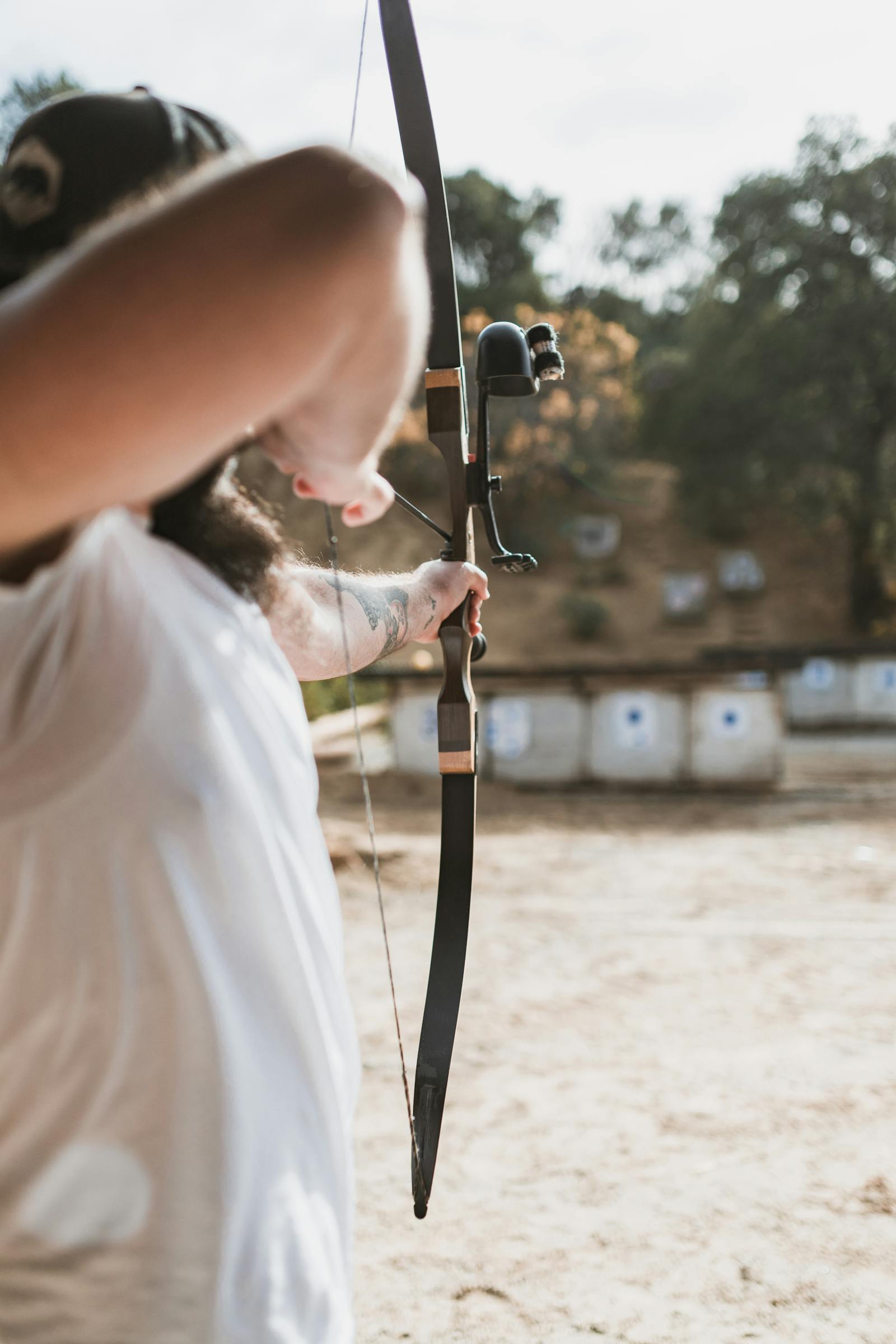
In barebow / instinctive there is no sight, so aiming happens through an unconscious process sometimes called the gun-barrel sight: the brain uses the arrow as a visual reference and calculates the trajectory without the archer being consciously aware of it. The system runs on muscle memory and proprioceptive calibration built across thousands of arrows. It works very well at distances you know and for archers who have put in the time that calibration genuinely requires, but becoming reliable at it demands very high practice volumes.
In Olympic recurve the sight is explicit: a pin that you align onto the target. The brain must hold three visual planes together, eye, sight pin, and target centre, and keep them aligned through to the release. It is a clear and adjustable system, with the sight adjusted by distance in click increments, but it asks for sustained attention to the aim on every single arrow.
In compound the system is dual: a peep sight (a small hole in the string you look through) combined with a scope (a lens with an aiming dot). The peep aligns you vertically and the scope gives you the aiming point, a redundancy that substantially reduces variability but that in return demands a more complex and meticulous setup.
Release biomechanics: the greatest dividing line
The release is probably where the three styles diverge the most, because there everything changes: the neural circuit involved, the muscles that activate, the duration of the movement, and its variability.
To put it another way: barebow / instinctive asks the nervous system to automate a fluid, fast release and accepts higher variability in exchange for a quick reaction time. Olympic recurve uses the clicker as an external trigger: it removes the conscious decision and produces a reactive release. Compound, finally, shifts the problem away from finger coordination and onto managing a mechanical trigger, which eliminates one source of neural noise but introduces a mechanical one. None of the three gives you precision for free: each simply moves the challenge to a different variable.
Muscle activation: different synergies for different styles
Several surface electromyography (sEMG) studies have compared how muscles activate across the three styles. The differences are clear, and they explain why transferring technique from one style to another is less straightforward than it might appear.
In barebow / instinctive the upper trapezius works more than in the other styles, while the posterior chains activate in a less defined pattern. Draw weight is usually lower (20 to 35 pounds), which allows a softer, more fluid activation, though also a less powerful one.
In Olympic recurve the posterior draw synergy commands the movement: lower trapezius, rhomboids, and latissimus dorsi coordinated with precision, while one of the key technical objectives is to suppress upper trapezius activity. Draw weights are moderate (30 to 50 pounds for competitive archers), and the division requires you to balance strength with refinement.
In compound, thanks to the drop in force at peak draw (the let-off, typically between 65 and 90%), the muscles work far less during the hold. Peak draw weight is high (50 to 70 pounds), but the holding weight is low (15 to 25 pounds). This allows longer aiming time without fatigue, but the technical demand shifts from strength to precision and stability.
Learning curve and accessibility
The styles also differ substantially in how long it takes to reach a reasonable level, and in what it costs, both financially and in effort, to get started. Thinking this through before you begin helps you avoid choosing blindly.
Barebow / instinctive
Slow curve in the first months (proprioceptive calibration takes time), then progressive and rewarding. Reaching a satisfying level for recreational shooting typically requires 12 to 24 months of regular practice.
Advantages: minimal setup, affordable equipment, a more immediate and contemplative experience. Well suited to those who want a more direct, meditative relationship with the bow.
Olympic recurve
A more structured technical curve thanks to an explicit aiming system. Visible results arrive more quickly (3 to 9 months for a basic level), but intermediate plateaus are more demanding to push through.
Advantages: well-codified coaching protocols, access to the FITARCO and World Archery competitive circuit, equipment that scales with your development. Well suited to those seeking a clear competitive pathway.
Compound
A fast technical curve in the first weeks, thanks to the assistive devices. Visible results in 1 to 3 months, but the path toward excellence requires meticulous technical management and specific mental skills.
Advantages: high precision from early on, low holding weight that allows archers with physical limitations to participate. Higher initial cost.
Which style to choose
There is no objectively better style, because the choice depends on what you want, your physical condition, your budget, the time you have, even the context in which you shoot. Three questions can help you find your direction.
The first: where do you want to end up. If you have ambitions of a competitive career, perhaps reaching a national team, the path is Olympic recurve or compound. If you are looking for a recreational, contemplative practice, barebow / instinctive fits well. If you want fast results and quick gratification, compound rewards you sooner.
The second: how much time can you realistically commit. Barebow / instinctive needs high volume to become reliable, whereas Olympic recurve and compound produce results with fewer arrows, though those arrows need to be carefully executed. Someone shooting two or three times a week will make a different choice from someone who can train at the range every day.
The third: what kind of relationship with the movement are you after. Barebow / instinctive is more direct and fluid, closer to the ancient roots of the bow. Olympic recurve is more technical and codified, almost a laboratory discipline. Compound is more engineering-oriented, built around optimising a complex mechanical system. All three are valid, but they are profoundly different experiences, and it is worth knowing what you are choosing before you commit.
Moving from one style to another
Some archers practice more than one style, either over the years or within the same period, and it should be said plainly that the transition is not painless. Each style requires motor patterns that are partly distinct, and what you have learned does not transfer automatically.
The most common move is between Olympic recurve and compound, in either direction. Many foundational skills carry over, but the release must be rebuilt from scratch. Going from barebow / instinctive to Olympic recurve means unlearning unconscious aiming and installing an explicit one. And the move from Olympic recurve to barebow / instinctive is often the hardest: you must let go of external references and trust proprioception, something the nervous system of an Olympic-trained archer strongly resists.
Practising two styles simultaneously is possible, but it slows progress in both. For competitive archers the practical rule is simple: one primary style, and possibly a second as an occasional variation at low volume. Spreading attention across three styles makes you mediocre in all three rather than strong in one.
Technological evolution and the identity of each style
Over the past twenty years bow technology has advanced considerably, yet the fundamental differences between the three styles have remained largely the same. Understanding how technical evolution has shaped practice helps clarify what it actually means, today, to pursue each bow style.
Modern compound has gained the most: more aggressive cams, let-off up to 90%, scopes with corrective lenses, increasingly sophisticated release aids. All of this has pushed the division toward near-mechanical precision, reducing the weight of pure technique and loading more onto equipment setup.
Olympic recurve has remained more conservative, and the innovations have been confined to materials (carbon in the limbs, aerospace aluminum in the riser) and accessories (sight, stabilisers), while the biomechanics of the shot are essentially unchanged over decades. That is precisely what makes the division so rewarding for those who invest in pure technical development.
Barebow / instinctive, paradoxically, has changed the least, because its philosophy openly rejects many innovations in order to preserve a more direct and ancestral relationship with the bow. The resurgence of traditional archery over the past fifteen years is probably a response to the growing complexity of the other two.
For anyone deciding where to start today, this context matters. Choosing compound means accepting a technologically complex system that needs to be managed and optimised. Choosing Olympic recurve means investing in pure technique, with a stable technology base. Choosing barebow / instinctive means embracing a pared-back, contemplative approach. These are three different practice philosophies, not simply three different pieces of equipment.
What the three styles share
Despite the biomechanical differences, certain principles apply to all three styles without exception. Recognising them keeps you from getting trapped in the technical details of a single division.
The first shared element is the role of the autonomic nervous system: in all three styles, shot quality depends on how well you regulate arousal and activation, keep fine muscular tremor in check, and sustain attention where it is needed. HRV, breathing, and pre-shot routines are pillars that support performance regardless of which style you practice.
The second is the centrality of postural stability: every style needs a stable base from which the motor system can work with precision. Centre of pressure, anticipatory postural adjustments, and core synergies are present in barebow / instinctive, Olympic recurve, and compound alike, even if the specific demands differ.
The third is the importance of deliberate practice over volume alone. In all three cases, shooting thousands of arrows without technical quality will not produce real improvement. What makes the difference is the quality of attention on each individual arrow, the conscious intention to work on a specific element, and the presence of feedback, internal or external, that allows correction.
These three principles are the real takeaway from this comparison: beyond the technical differences, shooting well means developing a set of competencies that transcend style. Changing division can be stimulating or necessary, but the foundations of practice remain largely the same.
One final practical note for those still deciding. The choice of style is not permanent: many archers change division over the years as their goals, physical condition, and available time shift. Starting with one style does not close the door to others, though every change has a cost in terms of technical transfer and recalibration. And understanding that style is a tool of practice, not an identity, frees you from the rigidity that tends to poison conversations between archers from different schools. Archery is rich enough to hold all its forms, and deep enough to genuinely reward anyone who chooses to practice it with method, whatever path they decide to take.
Every style is valid. Choose the one that fits your goals.
The hierarchy between styles is subjective, not objective. What matters is that your goals, the style you choose, and the time you can invest all line up. Switching is possible, but it costs: part of your accumulated practice gets discarded. That is reason enough to choose thoughtfully from the start.
Further reading. What you read here rests on the scientific literature. To keep the text readable I do not cite individual studies inline, but you will find the full reference list, over 120 studies and books, on the dedicated page.
Go to the bibliographySome things I take on directly.
I work on training and functional rehabilitation, on injury prevention and recovery, and on research. If you have a project or a collaboration in mind, or a question left over from what you have just read, write to me: I answer myself.