Part of the complete guide: How to improve your archery score
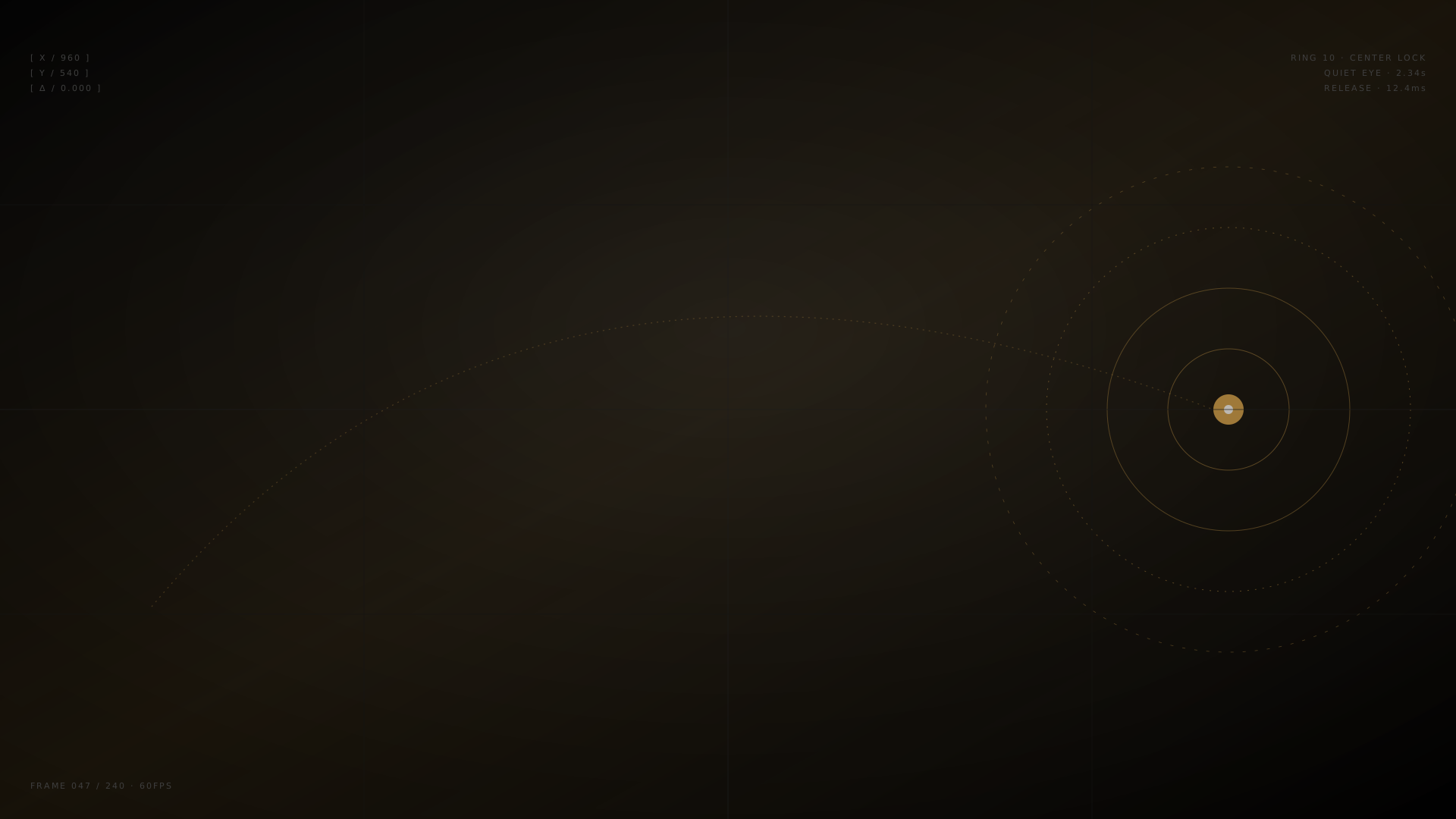
Quiet eye is the final stable fixation before the release, stable meaning micro-movements within 1 to 3 degrees of visual angle for at least 100 milliseconds. Olympic archers average around 2 seconds, beginners often under one. What predicts scores is consistency rather than duration: 4 seconds on one arrow and 1 on the next is worse than a shorter fixation held identically every time. I assess vision first, then train it inside real shooting rather than at a screen.
For decades, concentration was treated as a kind of mysterious gift: the skilled archer concentrates, the less skilled archer "loses concentration," and the discussion ended there. Then, in the 1990s, researchers began fitting eye-trackers to athletes in precision sports, recording every millisecond of eye movement. What they found changed how concentration is understood: it has a concrete visual signature that can be measured and trained.
It is called quiet eye, and it is one of the few truly reliable indicators of performance in sports that require precision aiming.
This article covers what it is, why it works from a neurological standpoint, which other components of the visual system can be trained, what mistakes are routinely made when attempting to train it, and how to build a rigorous protocol. It is a long read, because the subject demands it: quiet eye is one of those concepts that produces nothing when applied incorrectly, and can unlock performance that has been stuck for years when applied well.
What quiet eye is
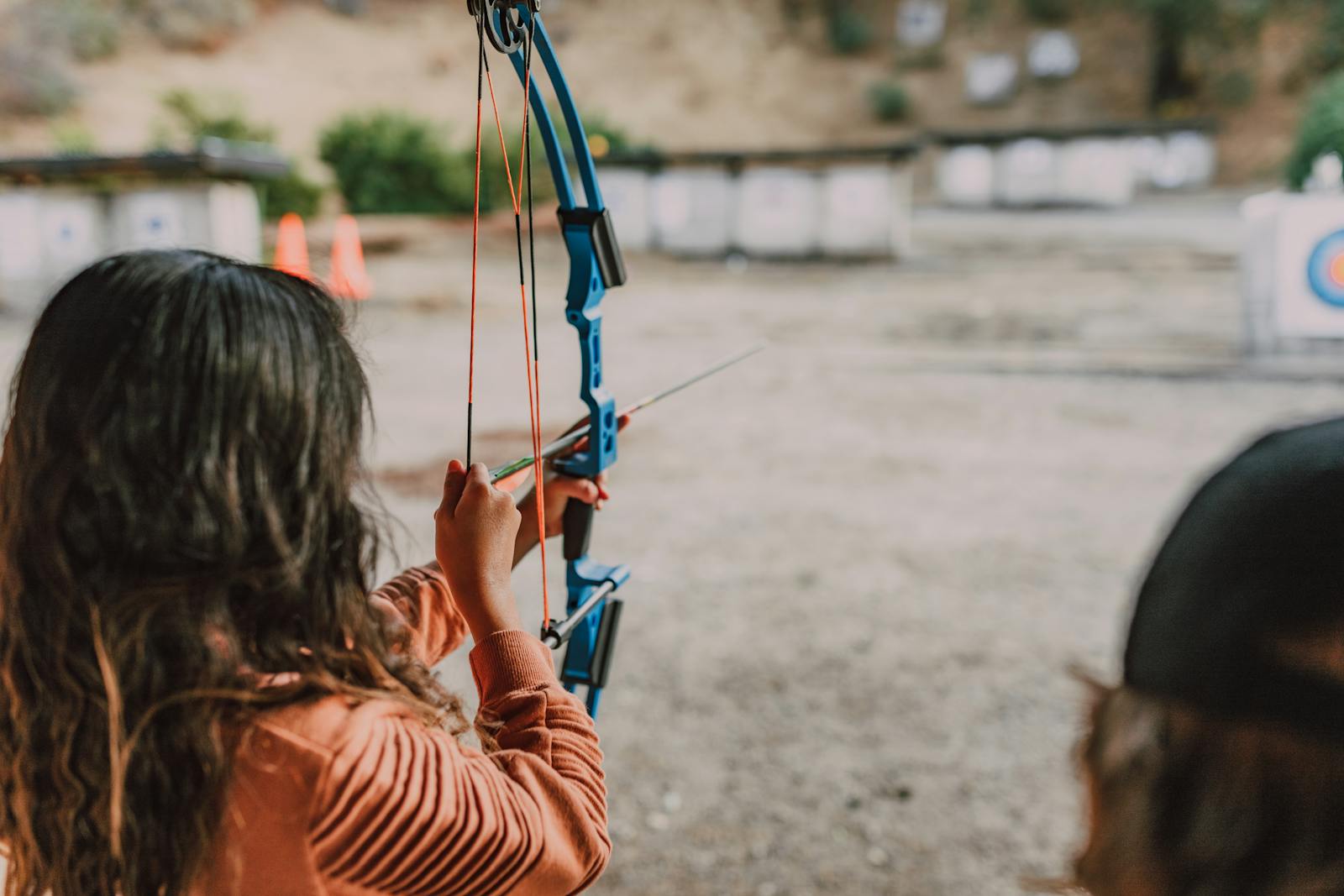
Quiet eye is the final stable fixation of the eye on a critical location, immediately before executing a precision movement. In archery, it is that moment when the gaze locks onto the gold of the target, or onto the arrow tip depending on the approach, and remains there through the release.
The word "stable" carries a precise technical meaning here, because the eye is never truly still: even during a fixation it constantly makes tiny movements that keep the retina active. In the research literature, a fixation is considered stable when these micro-movements remain within 1 to 3 degrees of visual angle for at least 100 consecutive milliseconds.
When archers at different levels are measured, certain quiet eye characteristics appear with considerable regularity: the most solid field data come from Olympic-level archers, where the average duration sits at around 2 seconds. In beginners the fixation is markedly shorter, often under a second, and struggles to form at all: the gaze keeps wandering right up to the release. The exact figures, though, vary considerably from study to study and with the measurement method.
The figure that matters most, however, is not average duration: it is consistency. An archer with a long but highly variable quiet eye, one shot at 4 seconds and the next at 1, scores worse than one with a shorter fixation held the same way every time. Repeatability outweighs absolute duration, and it is the detail that poorly designed visual training protocols almost always overlook.
Why a longer quiet eye improves scores
That quiet eye exists is not in question, given that it can be measured; the real question is: why does it work? Over twenty years, several explanations have been proposed, and three of them now hold up well and appear to act simultaneously.
Pre-activated motor programming
During the quiet eye period, the nervous system loads the motor programme for the release. The more time it has to do so, the more stable that programme becomes.
EEG studies show, during longer quiet eye periods, modulations in cortical activity (including increases in alpha and theta power) associated with a state of focused attention.
Attentional noise inhibition
A stable gaze on a relevant point suppresses distracting inputs: crowd noise, wind, self-criticism, fatigue.
Some EEG studies in archery report changes in cortical activity in elite archers during the quiet eye period. One hypothesis is that this goes together with quieter internal dialogue just before the release, but that is a plausible reading, not a direct measurement.
Oculomotor stabilisation
A steady gaze goes together with relaxed ocular muscles. One hypothesis is that this also ties in with a steadier head and torso, though the precise link remains to be clarified.
In other words the eyes stay still, the head moves less and the shoulders with it, to the point where quiet eye may be partly a motor stability effect and not only a cognitive one.
These three explanations are not competing: the idea is that they support one another. A longer quiet eye allows more time to prepare the movement, which may reduce the need for internal commentary; less self-talk would go hand in hand with a more stable eyes-head-shoulders system, which in turn sustains the quiet eye. Once triggered, it looks like a virtuous cycle. The difficulty lies in triggering it in the first place, and that does not happen without deliberate work on all three dimensions together.
Quiet eye is not about looking. It is about no longer thinking through your eyes.
During the quiet eye period, the cognitive system steps back and lets the already-learned motor programme run without interference. It is, literally, the moment when the archer is no longer deciding anything. Hence the paradox: thinking about quiet eye shortens it.
Visual training: beyond quiet eye
Quiet eye is only the tip of the iceberg: visual work in archery involves several other components, each of which can be trained and measured. Understanding them allows for more complete programmes and, more importantly, helps identify the actual bottleneck for each individual archer, because it is never the same for everyone.
The research picture on visual training protocols in precision sports points in a fairly clear direction: a few weeks of targeted work produce measurable effects on quiet eye and, more importantly, on average scores. The gains observed are real, but they vary considerably across studies and cannot be summarised in a single percentage. In a sport where the margins between two athletes of equivalent level are small, even a modest improvement counts.
One methodological point: visual training does not replace a functional optometric assessment. Before beginning quiet eye training, it is worth seeing a specialist, because the examination may reveal structural limitations, poor convergence, uncertain eye dominance, an accommodation problem, any of which would undermine any training protocol regardless of how well it is designed. The same error keeps recurring: working on the effect without first ruling out the cause.
Three common mistakes in visual training
Treating it as supplementary rather than integrated
Visual training works when it is embedded within actual shooting, not as an isolated exercise done at home.
Eye exercises in front of a screen for 10 minutes a day have limited transfer to archery performance, because task specificity is critical.
Measuring only duration, not variance
An average quiet eye of 2.5 seconds is meaningless if it swings between 4 seconds on one arrow and 1 second on the next.
Consistency is the real metric. Many amateur protocols optimise the mean while ignoring variance, producing apparent improvements that transfer poorly under competition conditions.
Skipping the baseline assessment
Many archers work on quiet eye without having undergone a functional optometric evaluation.
Limited convergence or uncertain eye dominance can limit the effects of any protocol. Assessment first, intervention second.
A basic protocol by phases
Drawing on what the research indicates, the following outlines a visual training protocol to use as a starting point for an intermediate or advanced archer. It works in phases rather than on a rigid calendar: the durations need adapting to the individual, but the sequence conveys the underlying logic of how such a programme is structured.
A large proportion of intermediate archers who follow this protocol report, after a few weeks, that their aim has become steadier. The interesting part is that the objective change (quiet eye duration and consistency) tends to arrive before the subjective feeling. This is another argument for measuring: without data, archers notice improvements only after they have already become sensations, and in the meantime they have spent weeks doubting whether any progress is being made.
Three intervention profiles
To make this concrete, here are three archetypes of intermediate archers with a diagnosable visual problem. These are constructed profiles, not real cases, but they illustrate how different the starting scenarios can be.
The fragmented quiet eye
Average quiet eye of 2.1 seconds (close to the elite target) but with very high variance: ranging from 4s to 0.6s between arrows.
The average conceals the reality: some arrows are excellent, others cost points. The problem is not duration but consistency.
The short quiet eye
Average quiet eye of 0.9 seconds, consistent but brief. Under competition it drops further to 0.5s, and the score follows.
The visual system has never learned to sustain a long fixation: dedicated training is required.
The limited converger
Normal quiet eye, but under competition the sight picture oscillates in an unexplained way. Optometric assessment reveals a compromised near point of convergence.
The cause is structural rather than cognitive, so it calls for visual rehabilitation first and an archery-specific protocol afterwards.
These three profiles carry a single message: visual work is not one protocol that fits everyone, but a family of interventions calibrated to each archer's individual profile. Without a diagnosis, any intervention succeeds by chance, and when things succeed by chance you do not know why, which means you cannot reproduce the result.
Accessible technology for visual training
One reason visual training took so long to reach recreational archers is how much the tools used to cost. Laboratory eye-trackers ran to tens of thousands of euros for years, the kind of equipment found only in national federation centres. Over the last five years, though, things have shifted considerably.
Today a wearable eye-tracker under 500 euros already yields perfectly usable data: Pupil Labs, entry-level Tobii Glasses, open-source solutions such as PupilCore. They are worn like a lightweight pair of glasses, record gaze at 120 to 200 Hz, and produce files that can be analysed with free software. They are not laboratory standard, but for measuring quiet eye duration and consistency they are more than sufficient.
If the hardware budget is not there, there is a surprisingly effective low-cost alternative: the visual stopwatch. An external observer, ideally with some experience, estimates the duration of the fixation on the gold arrow by arrow. It is imprecise, certainly, but for building a rough baseline on an intermediate archer it works: the difference between half a second and two and a half seconds is visible to any experienced eye.
One step up, still within reach of most, is video analysis at 60 to 120 frames per second. The archer's face is filmed during shooting, the moment when the gaze settles on the target is identified through head micro-posture and residual eye movement, and the time to release is counted. There is a margin of error here too, but within the same analysis session it is a repeatable and internally consistent method.
The takeaway is straightforward: any measurement is better than none, because even a rough visual estimate across 30 arrows tells you something useful, whereas waiting for the perfect instrument usually means never starting. It is better to begin with imperfect data and refine it along the way.
Beyond quiet eye: integration
It is worth closing with a reminder that gaze work does not act in isolation. A long quiet eye on a body that will not settle still produces an unsteady aim: the eyes are fixed but the torso is moving. A long quiet eye with a nervous system running too hot still produces tremor. And a long quiet eye without a consistent pre-shot routine still produces variability, because the timing sequence is never the same.
In other words: for visual training to produce real results, it needs to sit within a programme that also addresses the other performance levers. It is rare for an archer to have just one isolated problem; having several intertwined issues that reinforce each other is the norm. A serious approach therefore always starts with a comprehensive assessment before deciding where it is most productive to invest the work.
That said, quiet eye is probably the single variable that, when measured and improved, delivers the most visible results in the short term, and it is therefore often the first point of intervention once the foundations, posture and technique, are solid.
Frequently asked questions
What is the quiet eye in archery?
It is the final stable fixation of the eye on a critical location, just before the release. In archery it is that moment when the gaze locks onto the gold of the target, or onto the arrow tip, and stays there until the string is let go. A fixation counts as stable when the eye's micro-movements stay within 1 to 3 degrees for at least 100 consecutive milliseconds.
How long should the quiet eye last?
In the field, measuring Olympic-level archers, the average duration sits at around 2 seconds; in beginners it is markedly shorter, often under a second, and the stable fixation struggles to form. The exact figures vary considerably from study to study and with the measurement method. But the figure that matters most is not the average duration: it is consistency. A long but erratic quiet eye shoots worse than a shorter one that is the same every time.
Why does a longer quiet eye improve scores?
The proposed explanations are mainly three, and they act together. The first: during the quiet eye the nervous system has time to prepare the release, and EEG studies in archery show changes in cortical activity tied to this state of focused attention. The second: a steady gaze helps push distracting stimuli into the background. The third, more hypothesis than certainty, is that a steady gaze goes together with a steadier head and torso. The three interweave, and the hard part is not understanding that but triggering it.
How do you train the quiet eye?
A sensible approach is to proceed in phases: first a measurement-only phase to capture the starting point, then a period of specific work with external focus on the arrow tip, then a return to normal shooting while keeping an eye on the data, and finally a fresh check to compare before and after. The length of each phase and the fixation duration to aim for need calibrating to the archer: there is no single figure that works for everyone. There is only one fixed point: visual work pays off when it sits within actual shooting, not as an isolated exercise.
Do you need an eye exam before training the quiet eye?
It is good practice. Before investing weeks in the quiet eye it is worth having a functional optometric check: if there is an underlying convergence, eye dominance, or focusing problem, you risk working on the effect without having looked at the cause. Better to rule it out at the start than to discover it months later.
Further reading. What you read here rests on the scientific literature. To keep the text readable I do not cite individual studies inline, but you will find the full reference list, over 120 studies and books, on the dedicated page.
Go to the bibliographySome things I take on directly.
I work on training and functional rehabilitation, on injury prevention and recovery, and on research. If you have a project or a collaboration in mind, or a question left over from what you have just read, write to me: I answer myself.