Part of the complete guide: How to improve your archery score
Target archery uses fixed known distances, 18 metres indoors and up to 70 outdoors, with about 40 seconds per arrow. 3D puts you on unmarked stations between 5 and 45 metres, 90 to 120 seconds for two arrows, on uneven ground. Visual distance estimation becomes the defining skill: a 2 to 3 metre error at 30 to 40 metres can miss the vital zone. Target rewards repeatability across 72 or 144 arrows, 3D rewards resetting at every station.
3D archery and target archery are the two main disciplines in competitive archery today, alongside field archery. They share the fundamentals: stance, anchor, release, muscular coordination. Beyond that, they take quite different paths: target type, environment, distance estimation, time management, competition psychology. Understanding these differences allows you to choose the discipline that suits you best, and to practise both with a clear sense of what each one actually requires.
What follows covers what makes 3D archery a discipline in its own right compared to target archery, what specific skills it demands, what equipment works best for each, how physical and mental preparation differ, and what to watch for if you want to pursue both. The aim is a practical map for making an informed choice.
The fundamental differences
Target archery and 3D archery differ at the most fundamental level, in how they are structured, and that difference is where all the others come from.
Target
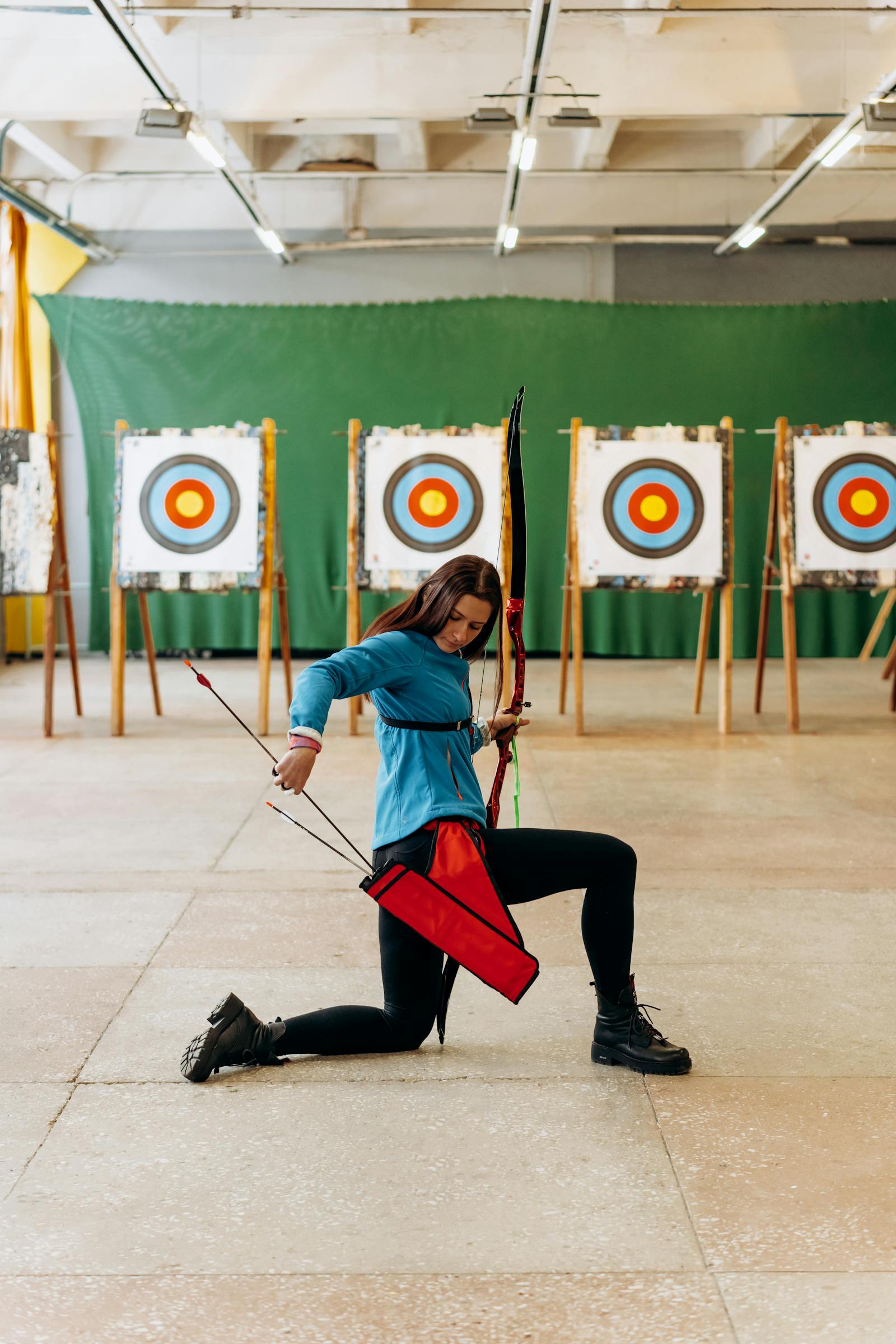
Target archery: a flat circular face with concentric rings, fixed dimensions, mounted on a standard stand at a known distance. Score depends on absolute accuracy relative to the centre.
3D archery: a three-dimensional animal replica (boar, deer, roe deer, bear) positioned in a natural setting. Scoring zones marked on the animal's body correspond to realistic vital areas.
Distance
Target archery: fixed, known distances (18 metres indoors; 30, 50, 70 metres outdoors, with 70 metres the Olympic recurve distance). The archer knows the exact distance and can set the sight with precision.
3D archery: variable and generally unknown distances, typically between 5 and 45 metres. The archer must estimate distance by sight, and estimation error is one of the biggest factors affecting the score.
Environment
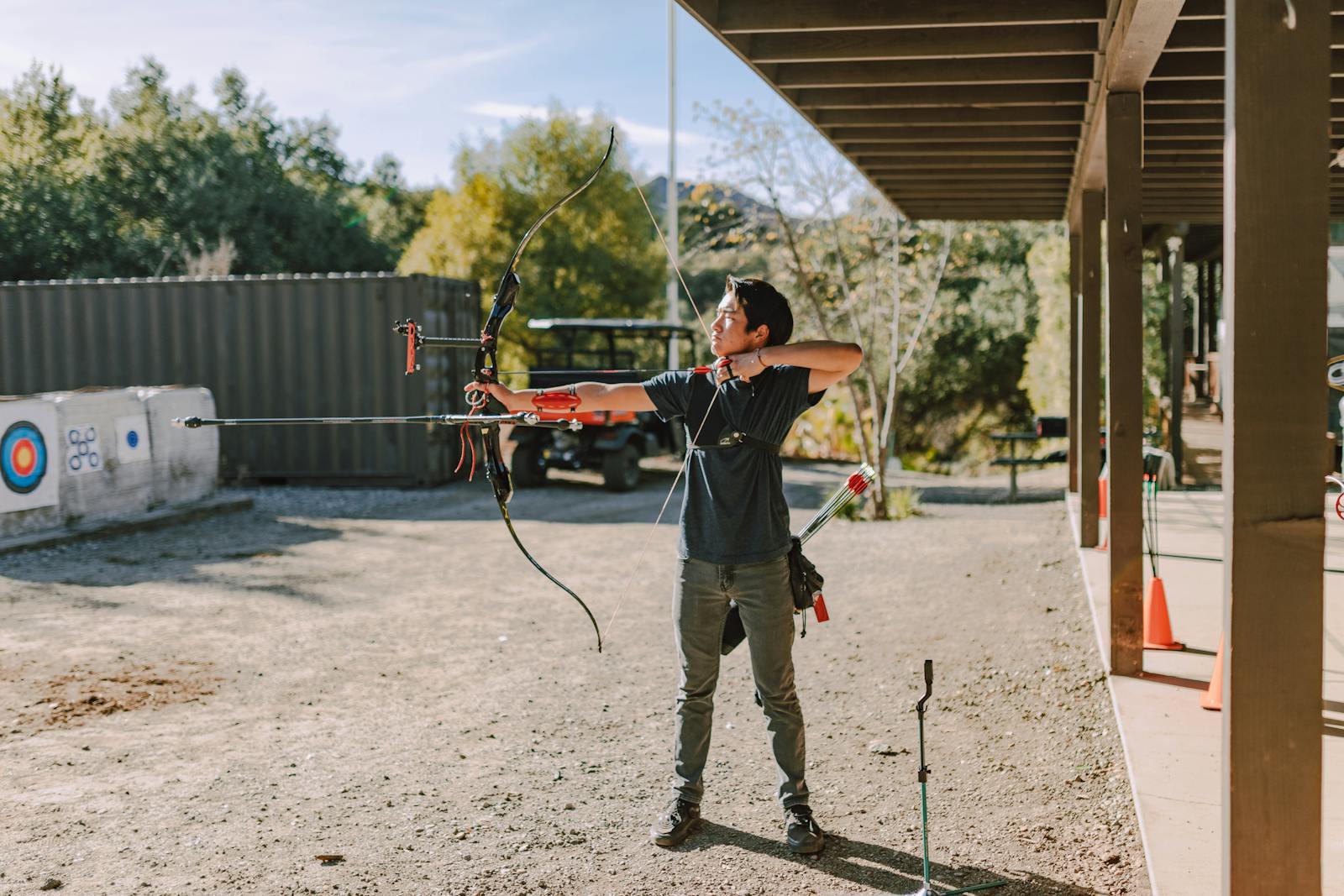
Target archery: open field, flat ground, standardised shooting position, relatively consistent light. Environmental variables are mainly wind and weather.
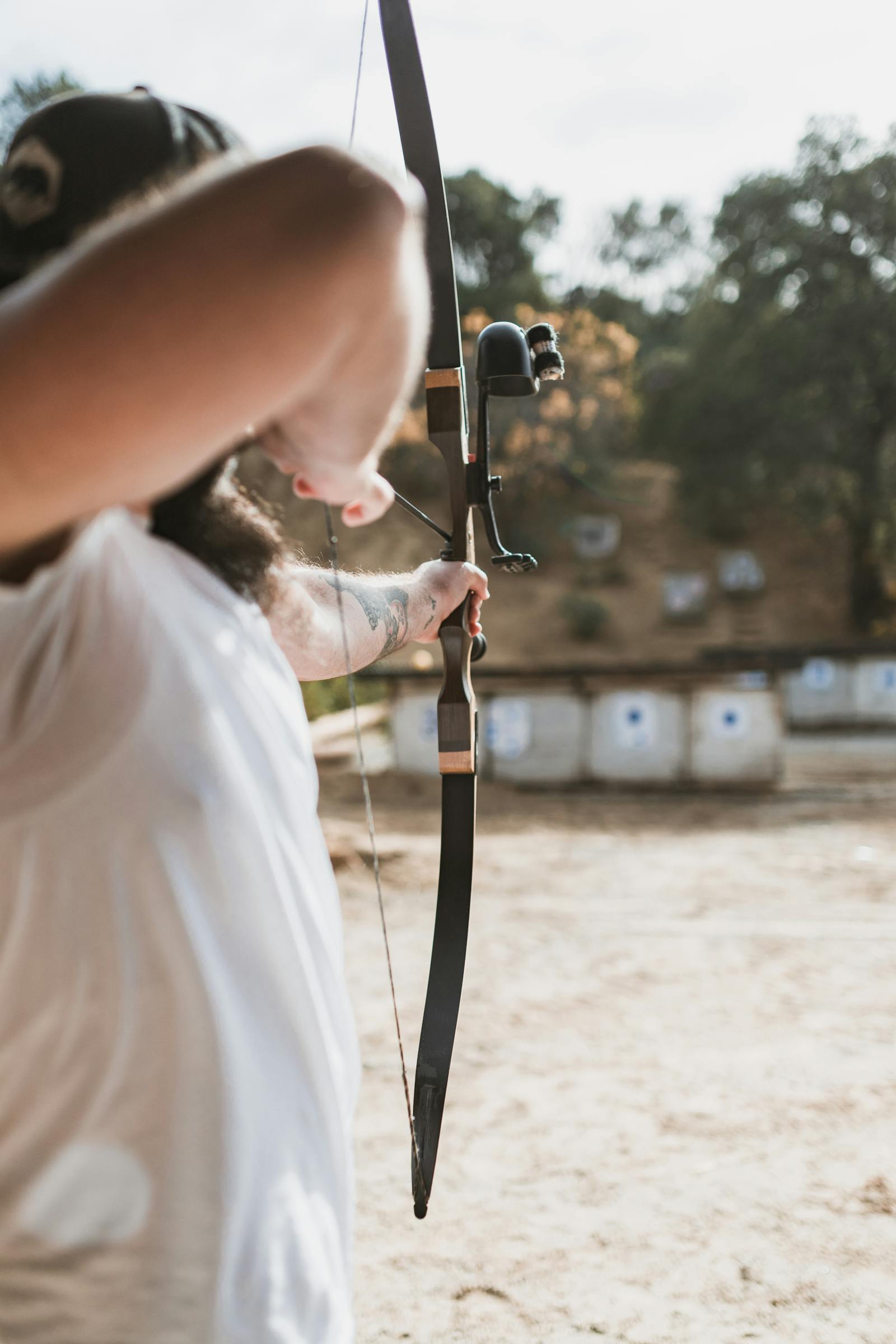
3D archery: woodland, uneven terrain, hills and descents, alternating shade and sunlight, partial visual obstructions. Each station is a unique context that must be assessed on its own terms.
Timing and rhythm
Target archery: time per arrow is set by the rules (typically 40 seconds), ends of 3 to 6 arrows with standardised rest periods. Rhythm is predictable throughout.
3D archery: typically 90 to 120 seconds total per station for two arrows, with variable travel time between stations. The overall course rhythm is less predictable.
Distance estimation: the core skill in 3D archery
If there is one skill that truly defines the 3D archer, it is visual distance estimation. Without an adjustable sight calibrated to distances you do not know in advance, you have to judge where to set your aim, or how much to hold over the target. And the margins are narrow: a 2 to 3 metre error at 30 to 40 metres can easily miss the vital zone entirely.
There are three main approaches to estimating distance, and the first is visual comparison: through repeated practice you internalise reference distances, 10, 20, 30, 40 metres, and compare the perceived distance to the target against those benchmarks you carry in your head.
The second is apparent target size: a standard-size animal replica appears smaller the further away it is, in predictable proportion. If you know the actual dimensions of the targets used in your competition circuit, you can estimate distance fairly well from how much of your visual field the target fills.
The third is terrain reading: trees, rocks, and vegetation between you and the target serve as reference points. Counting trees, mentally breaking the ground into segments of known length, using natural features as a rough ruler, all of this supports the estimate.
For those competing in 3D archery, training distance estimation is a practice in itself, separate from actual shooting. Walks through woodland where you estimate and then check with a rangefinder, combined with everyday mental exercises, the distance to a building, a tree, a road sign, gradually build the intuition the discipline requires.
Equipment: what changes
The ideal setup for 3D archery and the one for target archery differ in practical ways worth knowing. For those who practise both, a hybrid approach can work, but optimising for the specific discipline delivers advantages you can genuinely see in performance.
In compound, the differences also extend to the peep sight, which is wider in 3D archery where light conditions change constantly, to the release, with sensitivity tuned for each discipline, and to the scope, with lower magnification in 3D, where speed of reading matters more than millimetre-level aiming precision.
Competition psychology: two different profiles
The mental challenges of the two disciplines are also quite distinct: target archery rewards sustained consistency, 72 or 144 identical arrows where every tenth of a point matters, with pressure building through the later ends. The primary challenge here is maintaining clarity across a long session.
3D archery rewards adaptability and the ability to reset quickly: each station is a small self-contained event, an error at one does not carry over to the next, and pressure is immediate and local rather than cumulative. The primary challenge is treating each station as an isolated event, without letting what went wrong earlier influence what comes next.
These differences translate into genuinely different mental training needs, since the target archer benefits considerably from mindfulness practice and sustained attention work, whereas the 3D archer benefits from techniques for resetting between stations, and from learning to manage a pace that is never quite the same from one round to the next.
Discipline-specific physical preparation
Physical preparation also has different priorities across the two disciplines: for target archery, the emphasis is mainly on extended isometric endurance, because holding at aim over 70 metres demands prolonged stability, and on core stability, since the same posture must be reproduced reliably across hundreds of arrows in a day.
For 3D archery, other qualities come into play: general endurance (a 24-station course means several hours of walking on uneven ground), agility (irregular terrain demands quick muscular readiness), and the ability to adapt posture, since any station may require kneeling shots, awkward positions, or a wide range of angles.
3D archers benefit from specific training: long walks on uneven terrain, stability work on unstable surfaces (balance boards, soft mats), and shooting from atypical positions, kneeling, seated, on a slope, most of which is rarely needed for pure target archery.
Which one to choose
The two disciplines attract different people, and a few criteria help in making a considered choice between them.
Target archery suits those who value measurable precision, technical repeatability, tracking progress through comparable scores, and well-structured international competition. It is the Olympic discipline, the one with the greatest public profile.
3D archery suits those who value nature, course variety, the mental and emotional challenge of continuous change, moving during a competition, and the social dimension of a group shooting through the woods. It tends to attract archers with a hunting background and, more broadly, those who prefer the outdoors.
Practising both is possible, but the trade-offs should be clear. Technical volume has to be split between the two, equipment has to be calibrated or duplicated, and the specific competencies of each discipline have to be trained separately. This is why most competitive archers choose one as their primary discipline and shoot the other occasionally, as a variation.
The Italian competitive structure
In Italy, both disciplines are organised in a structured way by FITARCO. Target archery includes indoor championships (18 metres, on a single or triple vertical face) and outdoor ones (70 metres WA, FITA double distance). Competitions range from provincial trophies to national championships, through to world championships and the Olympics.
3D archery has its own calendar, with regional and national rounds and the Italian 3D championships. Targets follow international IFAA or World Archery 3D standards, with specific rules governing scoring zones, maximum distances, and time per station.
There is also field archery, a kind of third path that blends elements of the other two: flat circular faces, but on a woodland course, with some distances known and others unmarked. It is less widely practised, but offers an interesting middle ground for those who do not want to commit firmly to either target or 3D archery.
Training for both disciplines
For those who want to take both disciplines seriously, a few principles of integrated training tend to produce the best results without compromising either one.
The first is seasonal periodisation: dedicating blocks of weeks to one discipline at a time, following the prevailing competition calendar, with an outdoor target archery season running from May to September and a 3D archery season from October to April, as many Italian calendars do. This way the technical work is deep on one thing at a time, rather than shallow across both.
The second is shared fundamentals: everything that the two disciplines have in common, stance, anchor, clean release, muscular coordination, is trained regardless of which discipline is in focus. This represents 70 to 80% of the total technical investment, and transfers fully from one discipline to the other.
The third is targeted specialisation: in the weeks immediately before a specific competition, training concentrates on the technical details particular to that discipline, whether that is distance estimation for 3D archery, managing 144 arrows for outdoor target archery, or maintaining a steady rhythm for indoor.
The fourth is equipment managed with consistency: either two complete setups, higher cost but full optimisation for each discipline, or a hybrid compromise, accepting that neither setup will be ideal. The worst option is changing configuration constantly: it introduces technical variables that degrade performance in both disciplines.
With this integrated approach, a competitive archer can reach a good level in both disciplines, though typically somewhat below what they would achieve by concentrating on one alone. The choice between specialisation and versatility is personal, and depends on what you are actually after.
Cross-benefits between the two disciplines
Practising both disciplines, even without specialising, brings certain cross-benefits worth recognising. Understanding them helps you value the practice even when you are at an intermediate level in both.
For the target archer, occasional 3D archery builds adaptability in difficult situations, because managing uneven terrain, unusual angles, and shifting light develops a technical flexibility that proves useful on complicated outdoor target archery days. Wind management and handling weather variation in particular gain noticeably from 3D practice.
For the 3D archer, occasional target archery refines fine technique: the fixed, repeatable distances of target archery allow work on detail, anchor consistency, release quality, group repeatability, in a far more analytical way than 3D archery permits. And that more refined technique carries back into 3D, where the underlying quality of the shot still matters decisively.
The exchange works in both directions, and produces technically more complete archers. For many recreational competitors, the combination of one primary discipline and one secondary one is the best balance between technical depth and variety of experience.
It is worth noting that a number of accomplished archers, Italian and otherwise, have built significant careers across both disciplines: evidence that full competence in both is achievable, for those with the time and dedication to build it over years. These are uncommon cases, but they demonstrate that target archery and 3D archery are not technically incompatible: it is simply a matter of how you distribute volume and attention.
First steps for those wanting to start 3D archery
If you come from target archery and want to try 3D, a few practical points help you start well without becoming discouraged. First: go and watch a 3D course as a spectator or companion before shooting it yourself. Seeing how the competition works, the pace of the course, the stations, gives you a sense of context that no written explanation can provide.
Second: start with easy courses at shorter distances. Many clubs organise 3D practice sessions with targets at short ranges, 10 to 20 metres, which are well suited to beginners. Official competitions, with distances up to 45 metres, come later, once technique and estimation have consolidated.
Third: train distance estimation separately, away from actual shooting. Daily walks where you estimate the distance to trees, benches, buildings and then check with an app or a rangefinder gradually build the intuition the discipline requires. It is something you can do anywhere, at no cost, with measurable results in two to three months.
If you come from 3D archery and want to try target archery, the process mirrors that: start with an indoor competition at 18 metres, where short distances and a controlled environment make the transition smoother. The longer outdoor distances come later, with the 3D archer's technical background reread through the standards of target archery.
In both cases the practical rule is not to expect results straight away, because the specific competencies of each discipline take time and disciplined practice to become solid. Starting with realistic expectations, embracing the learning phase as part of the experience, and accepting being a beginner alongside specialists: that is how you genuinely enjoy widening your path in archery.
Target archery and 3D archery are two sports that share a bow.
Pursuing both seriously means accepting being intermediate in each, rather than very strong in one. For most archers, choosing a primary discipline and dedicating the larger share of their time to it produces better results. The other can remain a complementary pleasure, without the pressure of competition.
Further reading. What you read here rests on the scientific literature. To keep the text readable I do not cite individual studies inline, but you will find the full reference list, over 120 studies and books, on the dedicated page.
Go to the bibliographySome things I take on directly.
I work on training and functional rehabilitation, on injury prevention and recovery, and on research. If you have a project or a collaboration in mind, or a question left over from what you have just read, write to me: I answer myself.