Part of the complete guide: How to improve your archery score
Upper-body maximal strength averages 50 to 60% of male values, but a competitive woman draws 32 to 38 lbs against 42 to 48 for a man, well below either ceiling, so isometric endurance is the real limit. Greater joint flexibility, steadier sway at rest and finer finger precision push the other way. On the menstrual cycle the documented effects are small and the evidence weak, so I prefer a personal diary over three to six months to blanket rules.
Archery is one of the Olympic disciplines where women compete in equal numbers to men, with separate but equally prestigious World and European Championships. At the top level the absolute standard is high in both categories: the women's world records sit only a handful of points below the men's, and in mixed-team events it is often the women who decide the outcome.
Paradoxically, though, research on women's archery is far thinner than research on men's. Many studies are conducted exclusively on male subjects, and the findings are then taken as universally valid. Over the last decade that gap has been narrowing, but this remains one of the areas in sport science with the most room to grow.
This article covers what the research has documented on physiological and psychological sex differences in archery, how those differences affect performance, and specific considerations around strength, the menstrual cycle, competition anxiety and injury. The goal is to offer something useful both to female archers and to the coaches who work with them.

Biomechanical differences
The biomechanical differences between male and female archers are real, but smaller than is commonly assumed. Upper-body maximal strength is on average lower in adult women (a general physiological figure, not archery-specific: around 50-60% of male values for the upper body, somewhat closer in the lower body), but that figure refers to absolute maximal strength, not to the archery movement itself. In archery, the performance gap between the sexes is considerably narrower, because draw weight is never close to a maximum effort and what matters most is repeated isometric endurance.
The reason is straightforward: competition draw weight is never near the individual maximum, for men or women. A competitive female archer typically draws somewhere in the range of 32-38 lbs (with wide individual variation), a male archer around 42-48 lbs. In both cases the load is well below the achievable ceiling, and the limiting factor is isometric endurance rather than maximal strength. At a given training level, isometric endurance differs far less between the sexes than maximal strength does.
Research also documents specific advantages for female archers: joint flexibility is on average greater, which helps with correct bow-arm shoulder alignment. Postural stability at rest (centre-of-pressure sway) is marginally better, supporting steadier aim. And fine motor precision of the fingers is on average higher in women, a meaningful advantage for the release in recurve.
Taken together, these differences balance out: women have less maximal strength but more flexibility and finer motor precision. The result is that absolute levels in women's recurve are often comparable to men's, and on certain technical metrics, such as shot-to-shot consistency, women at the same level can actually outperform men.
Menstrual cycle and performance
One of the most studied topics in female sport science over the past decade is the influence of the menstrual cycle on performance. Research specifically on female archers remains limited, but a number of general principles can still be applied. It should be said upfront, though, that the documented average effects on performance are small and the quality of the evidence is still low: the most recent reviews point to a modest average effect, with a possible slight dip in the first days, and recommend a personalised approach rather than rules that apply to everyone.
The cycle brings hormonal fluctuations with documented effects on several physiological variables relevant to archery. During the follicular phase (roughly days 1-14) oestradiol rises; at ovulation (days 12-16) it peaks; during the luteal phase (days 14-28) progesterone rises instead. Each phase has its own effects on strength, pain perception, emotional stability, sleep quality and fluid retention.
Early follicular (days 1-7)
Characteristics: low oestradiol, possible cramping and menstrual pain, greater perceived fatigue. Archery performance is generally slightly reduced in the first 2-3 days.
Strategy: reduce training volume slightly and focus on fine technique rather than maximum volume. Avoid major competitions during these days where possible, though that is not always an option.
Late follicular (days 7-14)
Characteristics: rising oestradiol, high energy and motivation, reduced pain perception, strong emotional stability. Archery performance is often at a personal peak.
Strategy: maximise technical training volume in this window. Schedule important competitions during this phase when the calendar allows.
Early luteal (days 14-21)
Characteristics: rising progesterone, mild fluid retention, slightly elevated basal body temperature, maintained stability. Archery performance is generally good.
Strategy: continue regular technical volume, monitor hydration carefully (fluid retention can mask dehydration signals).
Late luteal (days 21-28)
Characteristics: PMS in some women, possible irritability, emotional instability, reduced motivation. Archery performance is variable, with possible dips in the 2-3 days before menstruation.
Strategy: active emotional regulation, possible volume reduction, focus on mental skills to manage the emotionally demanding phase.
It should be said clearly that individual responses vary enormously: some female archers notice clear fluctuations between phases, others almost no difference at all. For competitive archers who want to optimise, keeping a training diary that tracks cycle and performance together over 3-6 months reveals an individual profile, making informed decisions possible rather than guesswork.
For personalised nutritional, hormonal or pharmacological plans related to the menstrual cycle, a gynaecologist or sports medicine physician is the right person to consult. What you find here is general information and does not replace clinical advice tailored to your specific situation.
Competition anxiety: sex-specific patterns
Sport psychology has documented systematic differences in the way men and women experience competition anxiety. Research specifically on female archers has found that women report, on average, higher levels of cognitive anxiety (intrusive thoughts, worry about judgement) and higher perceived arousal (the activation you feel building before a shot), though the difference is not uniform across all phases of competition.
This has practical implications: both dimensions need to be managed, not only the cognitive one. Useful strategies therefore include both cognitive-level work (cognitive reappraisal, mindfulness, structured self-talk) and physiological techniques (breathing, progressive muscle relaxation). For female archers, on average, neglecting either of these two layers is a missed opportunity.
These are, again, statistical averages: every athlete is an individual, and the individual profile matters more than group generalisations. There are female archers whose profile more closely resembles the male pattern, and male archers whose profile more closely resembles the female one. Personalising the approach is always the better path.
Specific injuries and prevention
The injury picture in female archers differs in some respects from that in men, and three areas in women's archery deserve specific preventive attention.
The rotator cuff is the most heavily loaded area in both sexes, but in women its tendons are slightly thinner and proportionally less tolerant of repeated loading. Prevention requires targeted strengthening protocols, with particular attention to the infraspinatus and teres minor.
The carpal tunnel and other wrist pathologies affect women at statistically higher rates, partly for anatomical reasons: the carpal tunnel is somewhat narrower. For recurve archers, repeated finger pressure on the string and bow-arm wrist extension are risk factors, so prevention involves specific stretching and attention to wrist biomechanics.
Osteoporosis and bone health deserve attention over the medium to long term, because women in pre- and post-menopause carry a greater bone risk and archery, being a low-load sport, does not stimulate the skeleton the way high-impact sports do. Adding complementary activities such as brisk walking or bodyweight exercises benefits general health as well as performance.
Models and pathways in Italian women's archery
Italian women's archery has a long tradition of high-level competition spanning decades. Italian athletes have won Olympic, World and European medals across all categories, and today new generations of female archers are producing strong results on the international stage.
For girls and young women looking to start competing, the structured pathway offered by FITARCO provides opportunities at every level, from regional competitions to national championships and beyond. The women's side of the sport has grown considerably over the past fifteen years, and Italian clubs are generally welcoming and supportive of female participation.
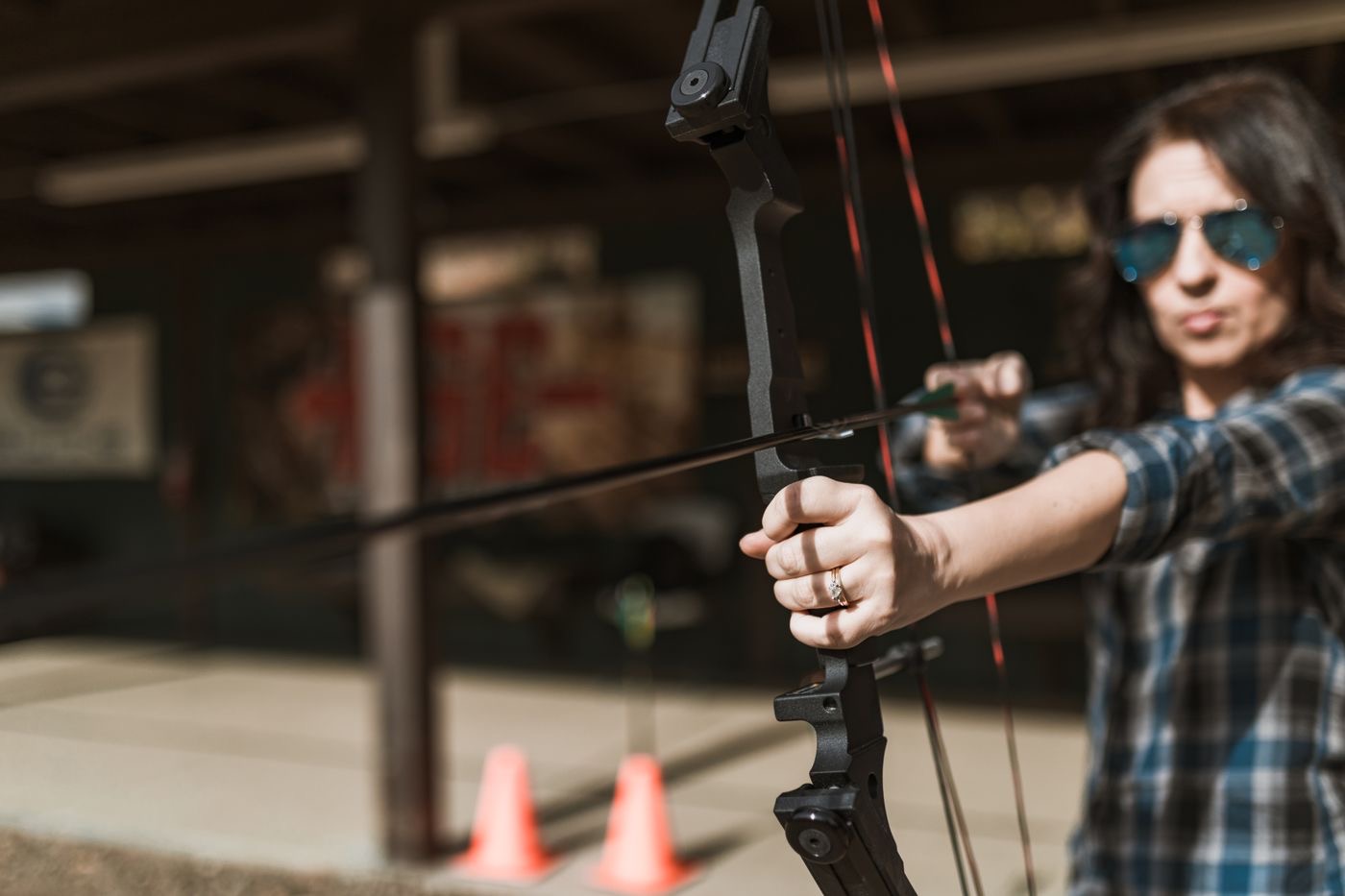
For adult women looking to start, or to return after a break, archery rewards accuracy and technique over raw strength, so it suits both as a primary sport and as a complement to other activities. And the club environment, usually intergenerational and welcoming, tends to make getting started easier than people expect.
Future research
As noted at the outset, research on women's archery still has considerable room to grow, and three areas in particular would benefit from development in the coming years.
The first is sex-specific hormonal physiology: how menstrual cycle fluctuations, menopause and any hormonal therapies affect performance in practice. Longitudinal studies on competitive female archers with detailed monitoring remain rare.
The second is competition psychology: how anxiety, motivation and responses to pressure differ in female archers, and which mental training interventions work best specifically for them.
The third is detailed biomechanics: sEMG, motion capture and video analysis studies on elite female archers, to build a biomechanical picture tailored to women rather than derived from a male template.
For anyone reading this as an intermediate archer, the overall message is a positive one: archery is a discipline in which women reach extraordinary levels, biological differences are often offset by specific advantages, and competitive opportunities are equal to those available to men. As dedicated research grows, training will become more targeted and more effective.
Pregnancy and archery: specific considerations
A topic that rarely comes up but genuinely matters for competitive female archers is how to manage practice during pregnancy and in the postpartum period. An important premise: every pregnancy is its own story, and decisions about sport during this period should always be made with a gynaecologist, never on the basis of general guidance like what you find here.
General guidelines in the literature indicate that, in a well-progressing pregnancy, moderate physical activity is normally recommended, and archery falls within the category of low cardiovascular-impact sports. That said, several things require careful attention: draw weight decreases gradually as pregnancy advances, the shooting stance needs to be adapted to accommodate the growing abdomen, and training volume typically drops in the later trimesters.
The postpartum period poses different challenges. Recovering abdominal and pelvic-floor strength takes time, and a gradual return is important to avoid diastasis recti or lumbar instability. For athletes aiming to return to competitive levels after childbirth, building that return in collaboration with a specialist physiotherapist is advisable.
In all of these situations, the first points of reference are a physician and a gynaecologist, ideally supported by a physiotherapist or an experienced archery coach. There are no universal prescriptions: each path needs to be tailored to the individual, with the right professionals.
One final note, and an encouraging one: many international female archers have returned to high levels after one or more pregnancies, sometimes shooting better than before. Archery allows a competitive career to continue through complex life phases, unlike many other sports where motherhood often marks the end of competitive activity.
The patience required to rebuild strength and technique after childbirth, combined with the right professional support, allows for gradual returns that benefit both health and the continuation of a sporting career. It is an opportunity many female archers underestimate, yet one that the literature of the past twenty years documents as entirely realistic.
The overall message of this article is one of both openness and specificity. Archery welcomes women with the same competitive opportunities as men, but the best training practice takes account of physiological and psychological characteristics that deserve dedicated attention. Female archers who recognise and integrate those characteristics into their development build stronger, longer careers than those who try to fit into generic protocols designed around male athletes.
Women's archery is not a reduced version of men's archery.
It has its own physiological, biomechanical and psychological characteristics, which call for a dedicated approach. For competitive female archers, building training around individual characteristics first, and group-level ones second, is the path to the best performance. Group generalisations are a starting point, not an endpoint.
Further reading. What you read here rests on the scientific literature. To keep the text readable I do not cite individual studies inline, but you will find the full reference list, over 120 studies and books, on the dedicated page.
Go to the bibliographySome things I take on directly.
I work on training and functional rehabilitation, on injury prevention and recovery, and on research. If you have a project or a collaboration in mind, or a question left over from what you have just read, write to me: I answer myself.