Part of the complete guide: How to improve your archery score
Spine matters most, and what counts is dynamic spine, not the number printed on the shaft: it depends on arrow length, point weight, actual draw weight and release style. On a 68-inch recurve, brace height sits between 8.5 and 9.5 inches, trading speed against forgiveness, and Olympic recurve keeps a positive tiller of 4 to 8 mm. The sequence runs base setup, bare shaft, walk-back, then a group test at the primary distance. An eighth of a turn on the string is below the noise floor.
Bow tuning is the process of optimising the bow-arrow system to achieve maximum consistency and accuracy in arrow flight. It is a field where oral tradition, codified technical knowledge, and scientific research all mix together, sometimes confusingly. The result, quite often, is hours spent adjusting parameters that change nothing, while overlooking the ones that would actually make a difference.
This article looks at what biomechanics and materials testing have genuinely documented about the main tuning parameters: the dynamic spine of the arrow, brace height, tiller, the archer's paradox, and the match between arrow stiffness and draw weight. The aim is to separate, once and for all, what can be optimised with data in hand from what is folklore dressed up as technique.
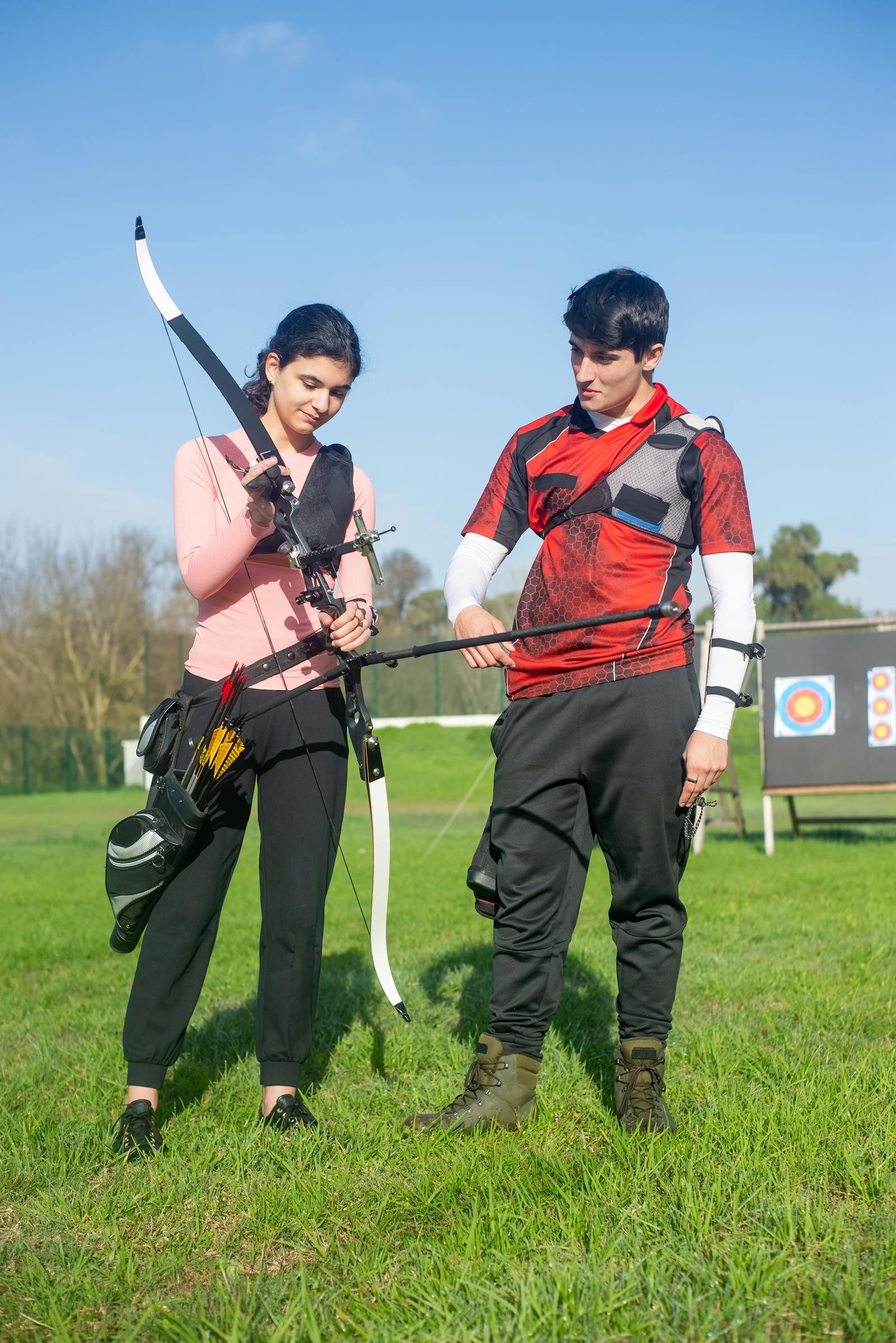
The archer's paradox: where it all starts
When you release the string, the arrow does not travel in a straight line toward the target. Behind that lies a phenomenon as strange as it is fundamental: the archer's paradox. During acceleration, the arrow bends around the bow, oscillates laterally, and only straightens out in the first few metres of flight. Without this flex, a rigid arrow would not even be able to clear the riser.
The paradox has been captured in slow motion since the 1930s and studied systematically over the past fifty years. The frequency at which the arrow oscillates depends on its physical properties, its stiffness (the spine) and how the weight is distributed, while the energy the bow imparts to it mainly governs the amplitude. Good tuning ultimately comes down to one thing: matching the arrow's spine to the bow's actual draw weight. When the two are in harmony, the arrow leaves with oscillations that dampen quickly and arrow flight stabilises early.
Arrow spine: the most important parameter
Spine measures how stiff an arrow is, expressed as its deflection (in thousandths of an inch or in millimetres) under a standard load. It is probably the most important parameter in tuning, and the one we have the most data on.
The general rule is straightforward: an arrow that is too stiff for the draw weight will impact on the side opposite the bow (to the left, for a right-handed archer); one that is too weak will impact on the same side. The bare shaft test, shooting arrows without fletching alongside fletched arrows, makes this visible at a glance. The group test, observing how arrows group at various distances, then confirms whether the match is correct.
The typical mistake among intermediate archers is treating the static spine printed on the shaft as absolute truth. What actually counts, the effective spine, depends on at least five things: arrow length, point weight, fletching weight, actual draw weight and release style, which is why the final match has to be verified on the range and not just calculated at a desk.
| If you change | Dynamic spine becomes | When you need it |
|---|---|---|
| Longer arrow | Weaker | Arrows reading stiff |
| Shorter arrow | Stiffer | Arrows reading weak |
| Heavier point | Weaker | Fine tuning without changing shafts |
| Lighter point | Stiffer | Fine tuning without changing shafts |
| Higher draw weight | Weaker | After a limb change |
The table gives you the direction, not the number. The absolute values still come from your shaft manufacturer's chart, which accounts for materials and geometry: that chart is the starting point, and these five levers are how you refine it on your own bow. For the starting length you can use the draw length calculator, then you work with point weight and plunger.
Reading arrow flight: fishtailing and porpoising
Tuning has an advantage few other areas of archery share: the arrow tells you what is wrong while it flies. You do not need instrumentation, you need to know what to look at. There are two faults visible to the naked eye, and they are told apart by the plane the tail oscillates in.
Fishtailing is oscillation in the horizontal plane: the tail snakes left and right, like a fish's fin. It is the fault that points to spine, to clearance (the arrow passing cleanly by the riser) and to the quality of the release. Porpoising is oscillation in the vertical plane: the tail waves up and down like a dolphin, and in the vast majority of cases there is a single cause, a nocking point out of position.
There is also an order of operations worth respecting, and it is the reason so many tuning sessions get stuck: fix the vertical plane first, then the horizontal. Porpoising has one cause and a simple correction, and as long as it is there it muddies the reading of everything else. Correcting spine while the nocking point is off means chasing a moving target.
| What you see | Plane | Likely cause | First move |
|---|---|---|---|
| Tail snaking left and right (fishtailing) | Horizontal | Spine not matched, clearance, release | Bare shaft test, then point weight or plunger |
| Tail waving up and down (porpoising) | Vertical | Nocking point out of position | Move the nocking point 1-2 mm at a time |
| Arrows landing crooked in no clear pattern | Both | Overlapping faults, often the release too | Close the vertical first, then read again |
The fine diagnosis, with the variants that confuse people most and the bare shaft protocol step by step, is in the dedicated article: Fishtailing and porpoising: what arrow flight says.
Brace height: the fundamental compromise
Brace height is the distance between the string at rest and the pressure point on the riser. It is one of the most debated parameters in recurve tuning, and also one of the most genuinely optimisable, given that you adjust it by twisting or untwisting the string, that is, by changing the number of twists.
What brace height governs is a basic trade-off: speed versus forgiveness. A lower brace height makes the arrow faster, because the string pushes it for longer, but it leaves less margin for technical error. A higher brace height slows the arrow down, yet is more forgiving: even a less precise archer can maintain decent groups.
For a 68-inch recurve, typical values fall between 8.5 and 9.5 inches (22-24 cm). Below that range the bow becomes too fast and twitchy; above it, energy starts being wasted. Finding the ideal brace height means testing on the range, a quarter turn at a time, and observing how groups close at 50-70 metres. There are no shortcuts: measure, shoot, compare.
Tiller: balancing the limbs
Tiller is the difference between the string-to-upper-limb distance and the string-to-lower-limb distance, both measured perpendicular to the string. In practice, it tells you whether the bow is working symmetrically or whether one limb is loading more than the other at full draw.
As a rule, in Olympic recurve, a positive tiller is maintained, with the upper limb sitting slightly further from the string, typically 4-8 mm, to compensate for drawing below the bow's geometric centre. When tiller drifts too far from that range, the release becomes asymmetric and the arrow oscillates vertically during flight.
It is one of the least studied parameters in the scientific literature, but among the easiest to verify on the range. A tiller that is out of specification shows up as groups that land consistently high or low relative to the aiming point, and stay that way even after adjusting the sight. A difference of 1-2 mm is enough to see a clear effect, particularly at longer distances.
What is folklore and what is science
Archery has accumulated a great many technical rules passed down by word of mouth: some hold up, others have no foundation at all. Knowing the difference lets you invest time where it genuinely matters, rather than chasing irrelevant details.
Tuning to the eighth of a turn
Some schools maintain that one eighth of a turn on the string makes a measurable difference. The materials literature suggests that changes this small fall well within the technical noise of the intermediate archer.
Reality: meaningful variation starts at half a turn and above. Below that threshold, execution error dominates whatever signal the tuning change might produce.
One spine for all distances
A common belief: a single perfectly tuned arrow works for every distance from 18 metres to 90 metres. In reality, arrow speed, and therefore effective dynamic spine, changes slightly with distance due to deceleration.
Reality: elite archers tune for their primary target distance and accept minor imperfections at others. Chasing perfection across all distances is a fruitless exercise.
Measuring brace height in real time
Brace height deforms marginally during the draw and then stabilises. Measuring it to the millimetre at every session is unnecessary: a new string settles within 100-200 shots and then varies by just a few millimetres over months.
Reality: measuring brace height once a week is more than sufficient. Checking it every session is needless obsession.
Arrow brands as equivalents
The belief: two arrows with the same nominal spine from different brands behave identically. In reality, manufacturing tolerances, materials, weight, and construction vary significantly between manufacturers.
Reality: changing arrow brand requires a complete re-tune. The printed spine is a guide, not a guarantee of equivalence across brands.
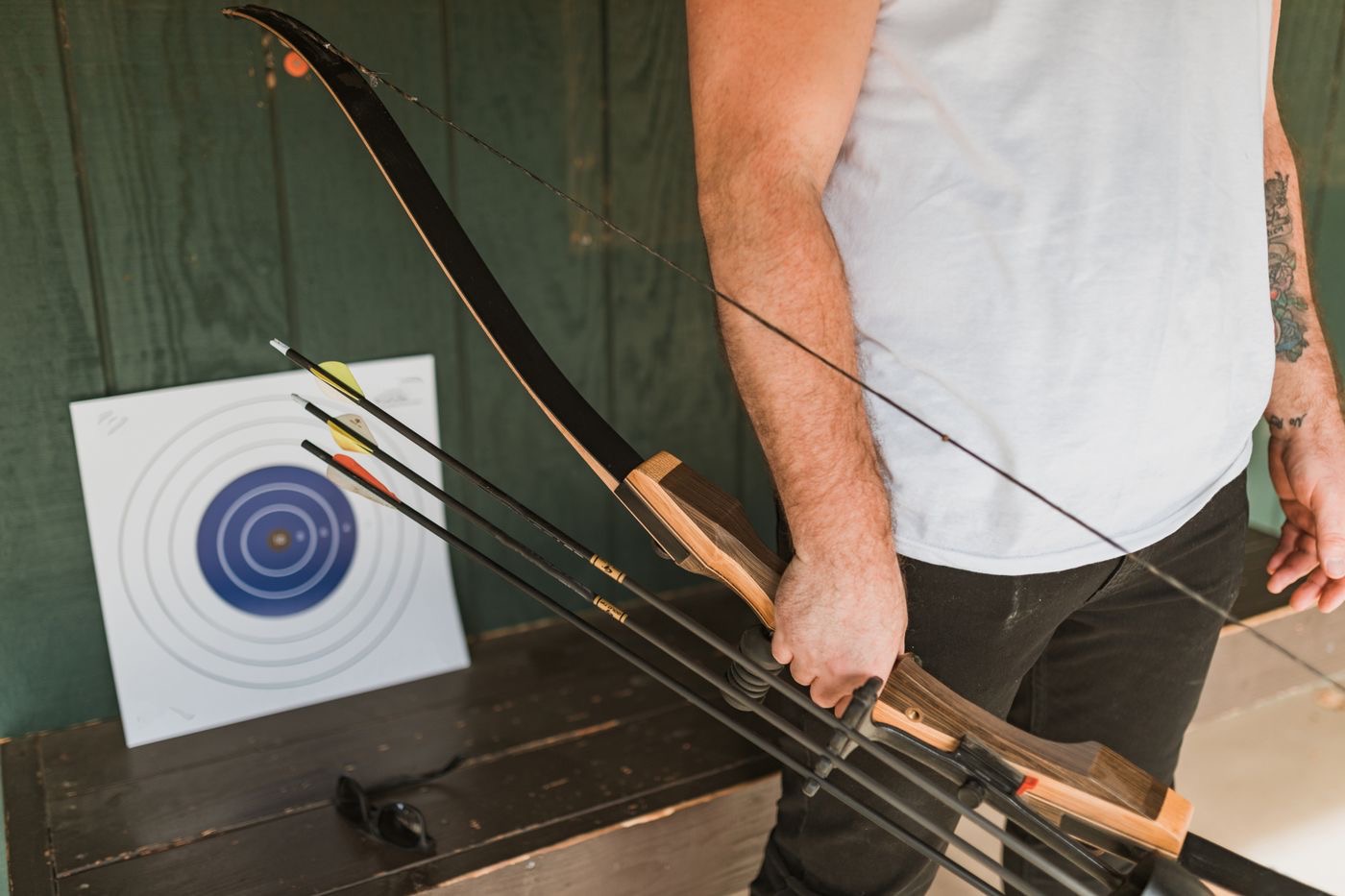
The evidence-based tuning process
A well-executed tune follows precise steps and in the right order, because skipping one, or reversing the sequence, leads to surface-level optimisations that fall apart at the first difficulty.
Standardised protocols exist for each of these tests, codified in the technical literature: manuals from Beiter, Easton, and Win&Win describe the procedures step by step. The practical takeaway is simple: a tuning done properly once will hold for weeks or months without needing adjustment; one done poorly stays unstable and forces constant tweaking, with no resolution in sight.
How often to re-tune
Once a basic tune is stable, redoing it from scratch is only worth the trouble when something in the system has changed, and there are four situations where a genuine re-tune is actually warranted.
The first is replacing a key component: new arrows, new limbs, new string, new points. Any modification to the bow-arrow system calls for a full verification, not just a sight adjustment.
The second is a change in draw weight, where as little as 2-3 lbs more is enough to shift the effective dynamic spine and make re-tuning necessary. The advice is to wait 2-3 weeks for muscular adaptation before touching the bow again: otherwise you risk compensating for a technical instability that is only temporary.
The third is a significant change in release technique. If the dynamics of the release have changed, from a clean follow-through to a more reactive one, or the reverse, the system responds differently and the tune needs to be rechecked.
The fourth is seasonal change, since intense cold or strong heat alters the behaviour of materials. Archers competing in very different climates may benefit from minor seasonal adjustments, though for most recreational archers this is a variable with little practical impact.
Tuning serves technique, not the other way around.
The intermediate archer with technical problems almost always looks to tuning for a solution to execution errors. It almost never works. Tuning can refine the margin that remains after technique is solid, but it cannot compensate for inconsistent form. Technique first, then tuning: that is the correct sequence, not the reverse.
When to work with a specialist
Basic tuning can be done independently, with the technical manuals that are widely available. For more advanced optimisation, though, there are interventions that require specific expertise and tools, and that is where working with an experienced specialist makes sense.
Arrow speed measurement with a chronograph requires dedicated instruments and the experience to interpret the readings. It provides an objective measure of the bow's energy efficiency and allows modifications to be evaluated with numbers rather than impressions.
Spectral analysis of arrow oscillation using high-speed video is a step further still, generally accessible only to national squads or biomechanics laboratories. It reveals the archer's paradox in detail and exposes imperfections that would never be visible to the naked eye.
For most recreational archers, however, a solid evidence-based tune using accessible tools, bare shaft, walk-back, group test, already gets very close to the maximum that current technique allows. Pushing beyond that level without first improving technique is effort for little return.
Compound tuning specifics
Compound tuning is a different world from recurve, because the greater mechanical complexity, cams, modules, cables, brings additional parameters, but also more instruments for precise adjustment. Four elements specific to compound deserve separate attention.
Cam timing is the synchronisation between the two cams. If it is out of specification, the release becomes asymmetric, groups elongate vertically, and the string wears unevenly. It can be checked visually, with the arrow perpendicular to the ground at full draw, or with dedicated tools.
Cam lean is the lateral rotation of the cams, and even small angles are enough to deflect the arrow sideways. It is corrected by twisting the side cables, an intervention that requires experience and should not be improvised.
Peep alignment is the alignment of the peep sight with the eye at full draw. A peep rotated even 5-10 degrees off the visual axis introduces aiming error, so it is oriented by hand at initial setup and then checked periodically.
Let-off is the percentage of force that drops after peak draw weight, and modern cams allow adjustment between 60% and 90%. The higher it is, the less effort is required during the aiming phase, but the less forgiving the bow is of release imperfections, so the choice comes down to the discipline and the individual archer's style.
One practical note worth keeping in mind: compound tuning requires dedicated tools, a compound press, draw board, laser level, that recurve archers do not own. For those starting from scratch with a compound, the initial investment in equipment is significant; the alternative is building a stable relationship with a technician who handles periodic adjustments. DIY without adequate tools, in this case, regularly creates more problems than it solves.
Whatever the discipline, the final principle of tuning remains the same: a slightly imperfect but stable setup that you know thoroughly is preferable to a theoretically perfect one that is always being worked on. When the system is stable, attention can go where it actually belongs, to technique, which is where the points that matter in competition are genuinely won.
The questions I get asked most
In what order should you tune a bow?
Basic setup first: nominal brace height, setup tiller, a standard nocking point and a theoretical spine correct for your draw weight and arrow length (for draw length and arrow length you can start from the calculator). Then the bare shaft test, then walk-back, and to finish, a group test at competition distance. Reversing the steps leads to surface-level optimisations that fall apart at the first difficulty.
What is the bare shaft test?
You shoot unfletched shafts alongside fletched ones. With no fletching to mask the flaws, comparing the two groups tells you whether dynamic spine is too stiff or too weak, and you correct it by working on point weight or arrow length.
How often should you re-tune?
A tune done properly holds for weeks or months. Redo it when a major component changes, arrows, limbs or string, when you change draw weight, 2-3 pounds is enough and it pays to allow 2-3 weeks of muscular settling first, when your release dynamics change and, for those competing in very different climates, at the change of season.
Can tuning fix my technique?
No: it trims the margin that remains, it does not fix inconsistent technique. If the group is scattered rather than shifted, the problem is almost always execution, not equipment: reading impact patterns shows you why. Technique first, then tuning: that is the right sequence.
Further reading. What you read here rests on the scientific literature. To keep the text readable I do not cite individual studies inline, but you will find the full reference list, over 120 studies and books, on the dedicated page.
Go to the bibliographySome things I take on directly.
I work on training and functional rehabilitation, on injury prevention and recovery, and on research. If you have a project or a collaboration in mind, or a question left over from what you have just read, write to me: I answer myself.